
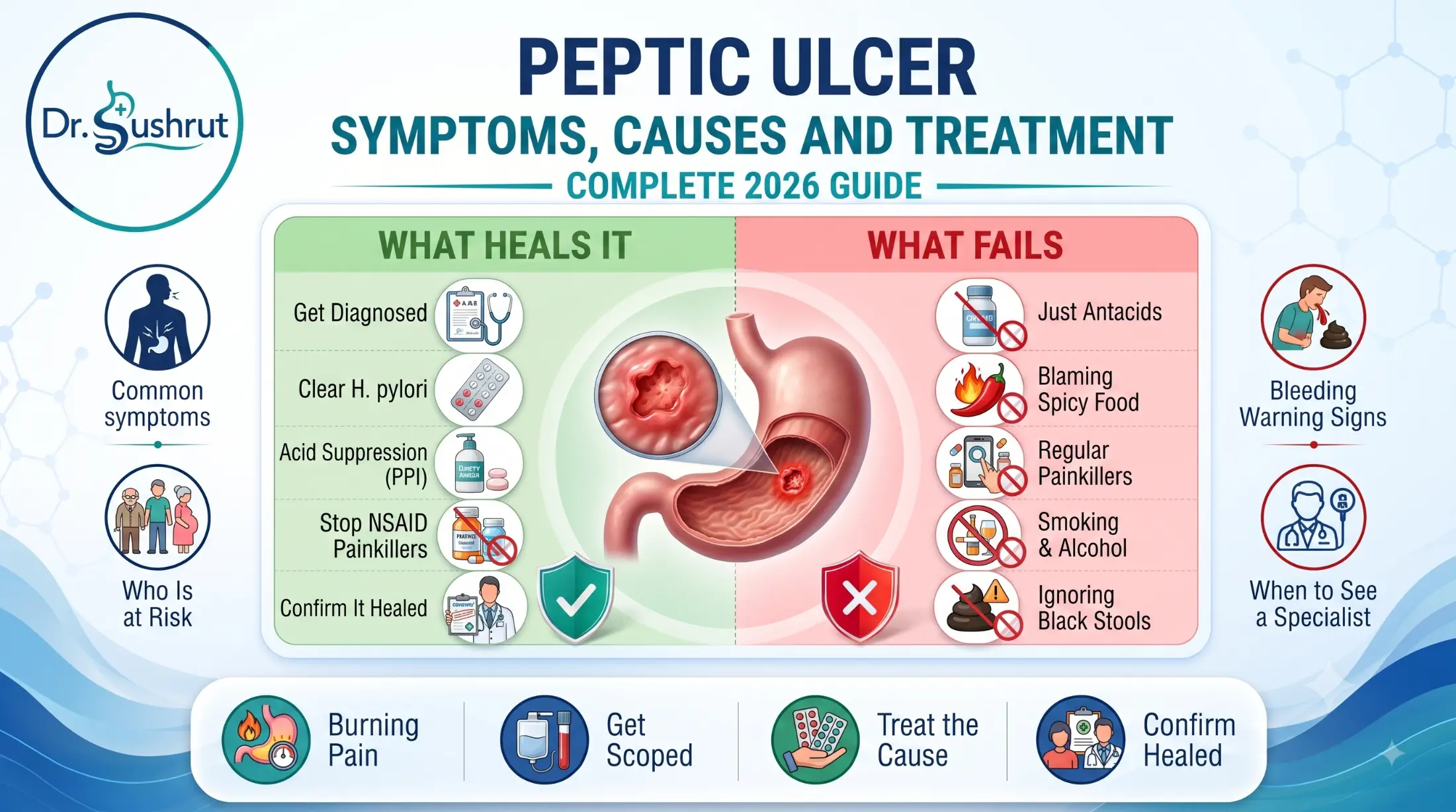
A burning or gnawing pain in the upper stomach that eases when you eat and returns a few hours later – often waking you at night – is one of the most recognisable signs of a peptic ulcer. These open sores in the stomach or upper intestine are common, and yet the everyday explanation for them is usually wrong. Spicy food and “too much stress” get the blame, while the two causes that actually matter go unaddressed. Most peptic ulcers are driven by either a stomach bacterium or the regular use of common painkillers, and both are treatable once identified. You can read a plain-language overview at the US National Institute of Diabetes and Digestive and Kidney Diseases.
This guide, written to reflect how a DM Gastroenterology specialist actually diagnoses and treats ulcers, explains what really causes them, the symptoms and warning signs to watch for, how they are confirmed, and why treating the cause matters far more than simply masking the acid.
Key Takeaways
- A peptic ulcer is an open sore in the lining of the stomach (gastric ulcer) or the first part of the small intestine (duodenal ulcer).
- The two main causes are H. pylori infection and regular use of painkillers (NSAIDs) – not spicy food or stress alone.
- Typical symptoms are a burning upper-abdominal pain, bloating and nausea; duodenal ulcers often ease with food, gastric ulcers often worsen with it.
- Black or tarry stool, vomiting blood, or sudden severe pain are emergencies that need immediate care.
- An endoscopy confirms the ulcer; treatment combines acid suppression with clearing H. pylori or stopping the offending painkiller.
What is a peptic ulcer?
A peptic ulcer is a break in the protective lining of the upper digestive tract, deep enough to expose the tissue beneath to stomach acid. When it forms in the stomach it is called a gastric ulcer; when it forms in the duodenum, the first part of the small intestine, it is a duodenal ulcer.
Peptic ulcer – an open sore that develops when the balance between stomach acid and the lining’s natural defences breaks down, allowing acid to erode the wall of the stomach or duodenum. It is a wound, not simply “excess acidity”, which is why it needs the cause treated rather than only the acid reduced.
The lining normally protects itself with a layer of mucus. When that defence is weakened – most often by infection or medication – acid reaches the wall and a sore forms. This is why the same acidity and heartburn keep returning despite antacids: the surface symptom is being treated while the underlying wound is left to persist.
What actually causes ulcers
Two causes account for the large majority of peptic ulcers, and neither is the one people expect:
- H. pylori infection – a stomach bacterium that inflames and weakens the lining. It is the single most common cause and, importantly, it is curable. Read more about H. pylori infection, testing and treatment.
- Painkillers (NSAIDs) – regular use of anti-inflammatory tablets such as those taken for joint or back pain reduces the lining’s protection and is the second major cause, especially in older adults.
- Contributing factors – smoking, heavy alcohol use and certain blood-thinning or steroid medicines raise the risk and slow healing.
Spicy food and stress can aggravate the symptoms of an existing ulcer, but they do not create one. This distinction matters, because a diet change alone will never heal an ulcer caused by a bacterium or a daily painkiller.
Symptoms of a peptic ulcer
The classic symptom is a burning or gnawing pain in the upper abdomen, but the pattern offers a clue to where the ulcer sits:
- A burning upper-stomach pain that, with a duodenal ulcer, often eases after eating and returns two to three hours later or overnight.
- Pain that, with a gastric ulcer, may instead worsen soon after meals.
- Bloating, frequent burping, nausea or a feeling of fullness after only a little food.
- Loss of appetite and, in some cases, unintended weight loss.
Some ulcers, particularly those caused by painkillers, cause little pain until a complication appears – which is exactly why the warning signs below should never be ignored.
Warning signs that need urgent care
Go to a hospital immediately if you have any of these
Black, tarry or sticky stool
Vomiting blood, or vomit that looks like coffee grounds
Sudden, severe and unrelenting upper-abdominal pain
Dizziness, breathlessness or fainting with any of the aboveThese point to bleeding or a perforation – complications of an ulcer that are medical emergencies, not something to manage at home.
How a peptic ulcer is diagnosed
An ulcer is confirmed by looking directly at the lining. The definitive test is an upper GI endoscopy, in which a thin camera examines the stomach and duodenum, the ulcer is seen, and a biopsy can be taken in the same sitting – both to test for H. pylori and, for a gastric ulcer, to rule out anything more serious. Because the cause guides the treatment, testing for the bacterium is a routine part of the work-up.
| Test | What it shows | When it is used |
|---|---|---|
| Upper GI endoscopy | Directly sees the ulcer and allows a biopsy | The definitive test, especially with alarm features or a gastric ulcer |
| H. pylori test (stool or breath) | Detects active bacterial infection | To find and treat the most common cause |
| Blood count | Checks for anaemia from slow bleeding | When bleeding is suspected |
Treatment: healing the ulcer and its cause
Treatment works on two fronts at once: reducing acid so the sore can heal, and removing whatever caused it. A strong acid-suppressing medicine (a proton-pump inhibitor) is usually given for four to eight weeks to let the lining repair. Alongside this, if H. pylori is present it is cleared with a specific antibiotic course, and if painkillers are responsible they are stopped or replaced and, where they cannot be avoided, paired with a protective medicine. Smoking and heavy alcohol both delay healing, so pausing them helps. For a gastric ulcer, a repeat endoscopy is often arranged to confirm it has fully healed. Rather than guessing with over-the-counter antacids, anyone with a suspected ulcer should book a proper evaluation, because treating the acid without treating the cause is what lets ulcers return.
| Approach | Pros | Cons |
|---|---|---|
| Acid suppression plus treating the cause | Heals the ulcer and prevents recurrence | Needs the full course and the cause correctly identified |
| Antacids alone | Brief symptom relief | Never heals the ulcer; the sore and its risks remain |
| Ignoring it | None | Risks bleeding or perforation, which are emergencies |
Future trends in ulcer care
Two shifts are shaping treatment. Rising antibiotic resistance means H. pylori is increasingly cleared with regimens chosen from local resistance patterns rather than a fixed recipe, which improves cure rates. At the same time, newer and more powerful acid-blocking medicines are making healing faster and courses shorter. The practical message is unchanged and, if anything, stronger: identify the cause accurately, treat it fully, and confirm healing – masking the acid alone is no longer good enough.
Conclusion
A peptic ulcer is a genuine wound in the digestive tract, but it is also one of the more fixable causes of long-standing stomach pain – provided the real cause is found and treated. If a burning upper-stomach pain, bloating or nausea keeps returning despite antacids, an endoscopy and an H. pylori test are usually the steps that finally settle it. And any sign of bleeding is a reason to seek care the same day.
Stomach pain that keeps coming back no matter what you take?
Dr. Sushrut Singh, a DM Gastroenterology specialist, confirms ulcers on endoscopy, treats the underlying cause rather than just the acid, and checks that the ulcer has healed. Consultations are at the Gaur City clinic in Greater Noida West, with endoscopy available at Fortis Hospital, Sector 62.
Call or WhatsApp +91 93153 54431 to arrange an assessment. Treating the cause is what stops an ulcer returning.
Frequently Asked Questions (FAQs)
Is a stomach ulcer caused by spicy food?
No. Spicy food can irritate an existing ulcer, but it does not cause one. The great majority of ulcers are due to H. pylori infection or the regular use of painkillers.
Can a peptic ulcer heal on its own?
Small ulcers may settle, but they commonly return if the cause is untreated, and an unhealed ulcer can bleed. Proper treatment with acid suppression and clearing the cause gives reliable, lasting healing.
How long does an ulcer take to heal?
Most ulcers heal within four to eight weeks of correct treatment. A gastric ulcer is often re-checked by endoscopy to confirm complete healing.
Is an ulcer dangerous?
Most heal well with treatment, but an untreated ulcer can bleed or perforate, which are emergencies. Black stools, vomiting blood or sudden severe pain need immediate hospital care.
Do I need an endoscopy for an ulcer?
An endoscopy is the definitive way to confirm an ulcer, test for H. pylori and, for a gastric ulcer, rule out anything more serious. Your specialist will advise if it is needed based on your symptoms and age.