
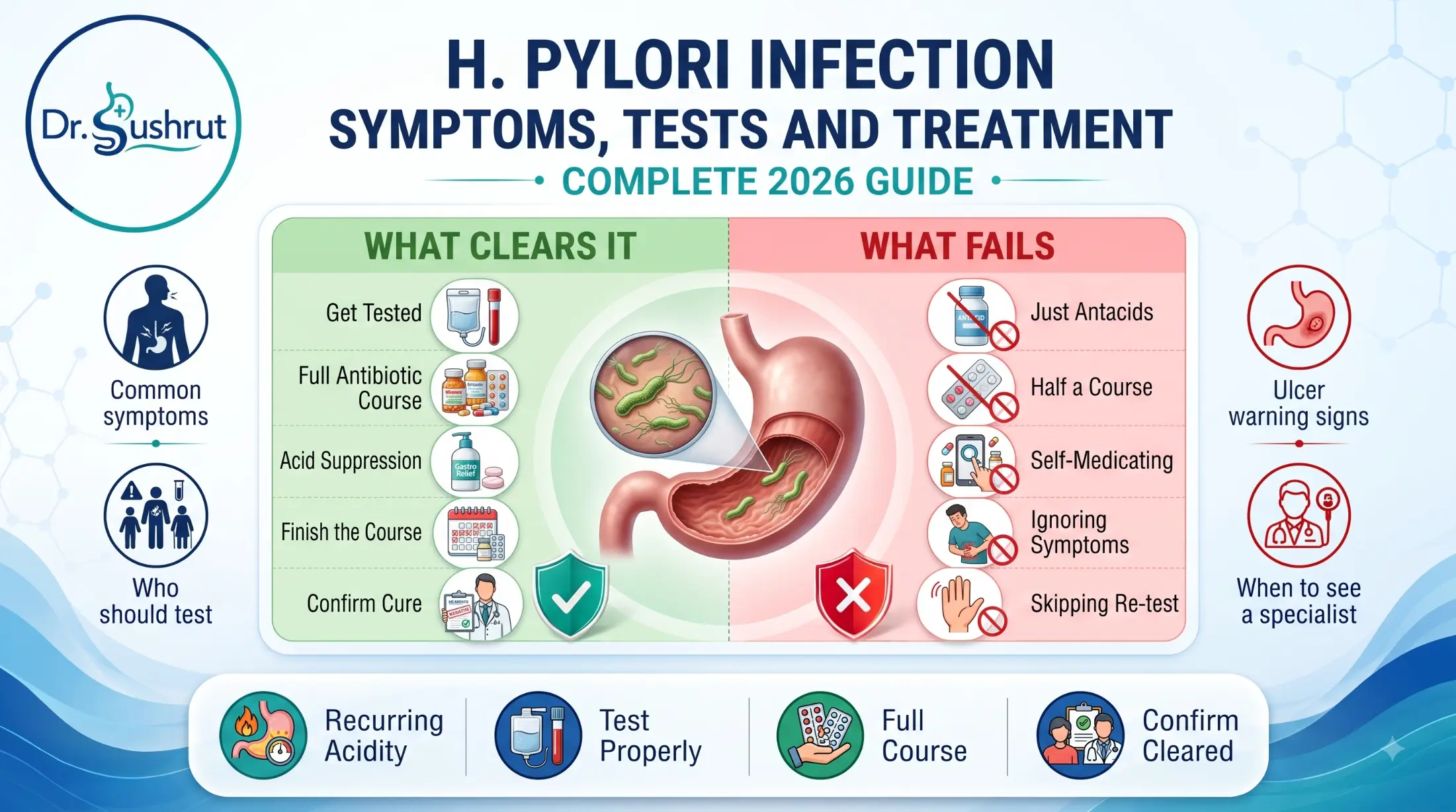
If you have battled recurring acidity, a gnawing upper-stomach pain or bloating that keeps coming back despite antacids, a common stomach bacterium called Helicobacter pylori may be the reason the problem never fully clears. It is remarkably widespread – a global meta-analysis estimates that about half of the world’s population carries H. pylori – yet many people are treated for “gastritis” for years without anyone testing for the one infection that could be driving it.
Plenty of articles mention H. pylori in passing. This guide, written to reflect how a DM Gastroenterology specialist actually diagnoses and clears it, explains who should be tested, which test to choose, why the right treatment matters, and how to confirm the infection is truly gone rather than just quietened.
Key Takeaways
- H. pylori is a common stomach bacterium that can cause gastritis, peptic ulcers and, over long periods, raise stomach cancer risk.
- Many carriers have no symptoms; those who do often have upper-abdominal pain, recurring acidity, bloating, nausea or early fullness.
- It is diagnosed with a stool antigen test, a urea breath test, or a biopsy taken during endoscopy – a blood antibody test cannot confirm active infection.
- Treatment is a specific 10 to 14 day combination of antibiotics plus acid-suppressing medication, not a single tablet.
- A confirmation test after treatment is essential, because resistance can leave the infection behind.
What is H. pylori?
H. pylori is a spiral-shaped bacterium that survives in the harsh acid of the stomach by burrowing into its protective lining, where it triggers long-term inflammation.
Helicobacter pylori (H. pylori) – a bacterium that colonises the stomach lining and is a major cause of chronic gastritis and peptic ulcers. It is usually acquired in childhood and can persist for decades unless specifically treated.
Because it lives quietly, most people never know they carry it. In those it does affect, it weakens the stomach’s defences and lets acid irritate the lining, which is why the acidity and heartburn keep returning no matter how many antacids are taken. Clearing the bacterium, where it is present, is what finally breaks that cycle.
Symptoms of H. pylori infection
When symptoms do occur, they tend to include:
- A dull or burning pain in the upper abdomen, often worse when the stomach is empty.
- Recurring acidity, reflux or a sour taste that antacids only briefly relieve.
- Bloating, frequent burping, nausea or feeling full after only a few bites.
- Loss of appetite and, in some cases, unintentional weight loss.
Warning symptoms – black, tarry stool, vomiting blood, difficulty swallowing or significant weight loss – suggest an ulcer or something more serious and need urgent specialist assessment, not home remedies.
Who should be tested
Testing is worthwhile, rather than routine for everyone. A specialist typically recommends it for people with ongoing indigestion, a known or suspected peptic ulcer, those on long-term pain-killers with stomach symptoms, anyone with a family history of stomach cancer, and certain blood conditions. Where alarm features are present or the patient is older, a camera test of the stomach is arranged so the lining can be seen directly and a biopsy taken in the same sitting. Testing also matters before starting long-term anti-inflammatory or blood-thinning medicines, which can irritate a stomach that already harbours the bacterium and tip it into an ulcer. Matching the test to the person avoids both under-diagnosis and needless treatment.
How H. pylori is diagnosed
There are three reliable ways to confirm an active infection, and one that should not be used alone. Where the stomach needs to be examined for another reason, the bacterium can be picked up from a biopsy taken during an upper GI endoscopy in the same visit.
| Test | How it works | Preferred use |
|---|---|---|
| Stool antigen test | Detects bacterial protein in stool | First-line, simple, non-invasive |
| Urea breath test | Detects the bacterium’s activity in a breath sample | Accurate confirmation and post-treatment check |
| Endoscopy with biopsy | Direct sampling of the stomach lining | When endoscopy is needed anyway or alarm features exist |
| Blood antibody test | Detects past exposure | Not reliable for active infection – avoid as the sole test |
Acid-suppressing medicines and recent antibiotics can produce false results, so a specialist advises when to pause them before testing.
Treatment: clearing the infection properly
H. pylori is cleared with a planned combination, not a single antibiotic. The standard is a 10 to 14 day course of two or three antibiotics together with a strong acid-suppressing medicine, chosen with local antibiotic-resistance patterns in mind. Completing the full course exactly as prescribed is what decides success, because a half-finished course is the main reason the bacterium survives and returns resistant. If the first course fails, a different combination is used rather than repeating the same one. Resistance to the common antibiotics has risen across the region, so the drugs are chosen from current local patterns rather than an old fixed recipe. Anyone who has struggled with recurring stomach symptoms should book a proper evaluation instead of self-medicating, because guessing the regimen is what breeds resistance.
Roughly four weeks after finishing treatment, a breath or stool test confirms the infection is gone. This step is not optional – symptom relief alone does not prove the bacterium has cleared.
| Approach | Pros | Cons |
|---|---|---|
| Full guided antibiotic course | High cure rate, breaks the ulcer cycle | Needs strict adherence for 10 to 14 days |
| Self-medicating with antacids | Brief symptom relief | Never clears the bacterium; drives resistance |
| Confirmation test after treatment | Proves the infection is gone | An extra visit, but essential |
Future trends in H. pylori care
Rising antibiotic resistance is reshaping treatment. Susceptibility-guided therapy, where the regimen is chosen from resistance testing rather than a fixed protocol, is improving cure rates, and newer acid-blocking drugs are making regimens shorter and more effective. Research into vaccines and into the balance between clearing the bacterium and protecting the wider gut microbiome continues. The practical takeaway is that treatment is becoming more tailored, which makes an accurate diagnosis and follow-up test matter more, not less.
Conclusion
H. pylori is one of the most treatable causes of long-standing stomach trouble, but only when it is tested for, cleared with a complete guided course, and then confirmed gone. If acidity, upper-abdominal pain or bloating keep returning despite antacids, testing for this one bacterium is often the step that finally ends the cycle.
Stomach symptoms that keep coming back no matter what you take?
Dr. Sushrut Singh, a DM Gastroenterology specialist, tests for H. pylori the right way, prescribes a complete resistance-aware course, and confirms the infection has cleared afterwards. Consultations are at the Gaur City clinic in Greater Noida West, with endoscopy available at Fortis Hospital, Sector 62.
Call or WhatsApp +91 93153 54431 to arrange testing. One accurate test can change how you feel for good.
Frequently Asked Questions (FAQs)
Is H. pylori serious?
Most carriers have no problems, but in those it affects it can cause ulcers and long-term inflammation, and over many years it raises stomach cancer risk. That is why symptomatic infection is worth clearing.
Can H. pylori be cured permanently?
Yes. A complete, correctly chosen course clears it in most people, and a confirmation test proves it is gone. Reinfection in adults is uncommon.
Which test is most reliable for H. pylori?
A stool antigen test or a urea breath test is preferred because both detect active infection. A biopsy during endoscopy is used when endoscopy is needed anyway. A blood antibody test alone is not reliable.
Will antacids treat H. pylori?
No. Antacids and acid-blockers ease symptoms briefly but do not remove the bacterium. Only a specific antibiotic combination clears it.
Do I need a test after finishing treatment?
Yes. A breath or stool test about four weeks after treatment confirms the infection is gone, because feeling better does not guarantee the bacterium has cleared.