
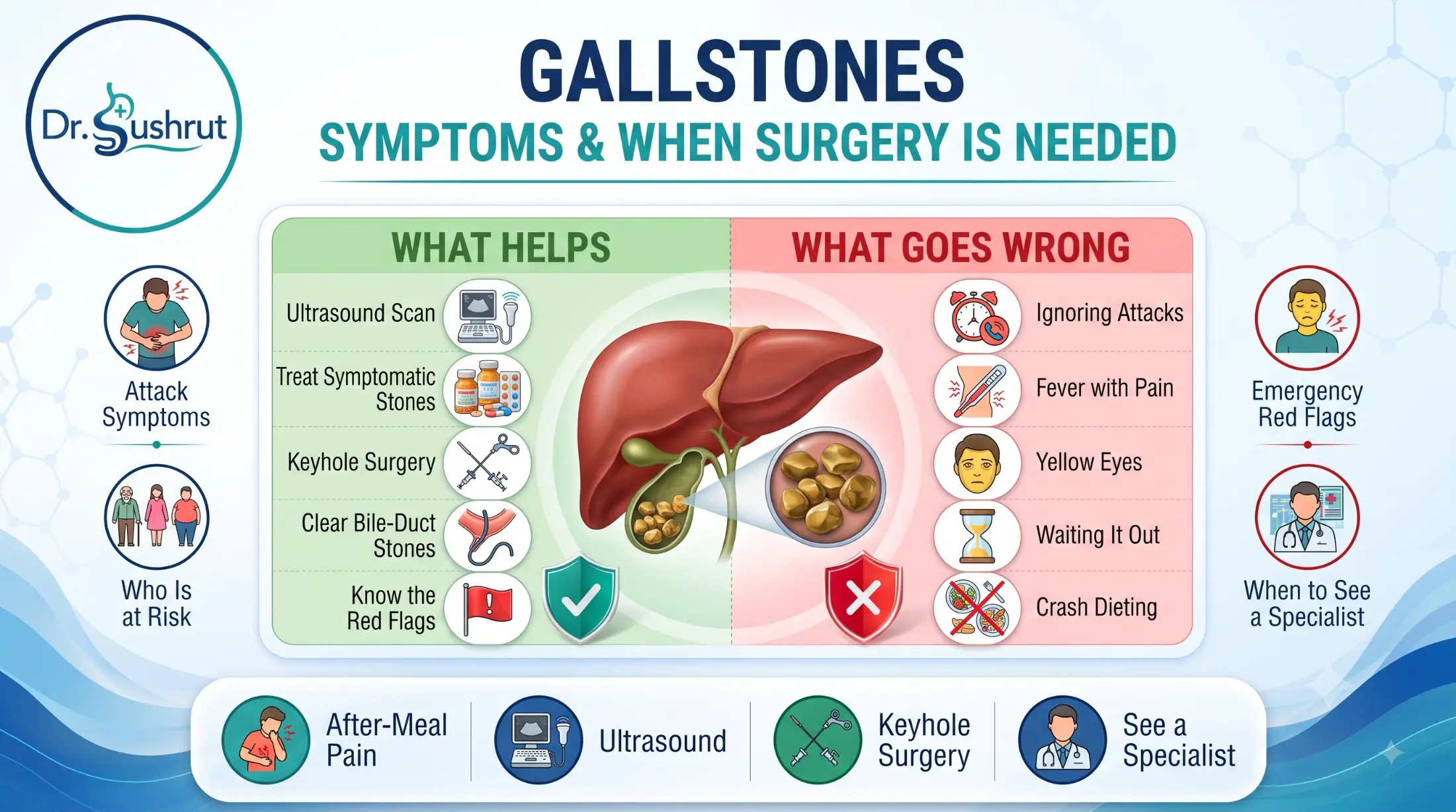
A sudden, intense pain high in the abdomen that grips you an hour or two after a rich or oily meal – sometimes spreading to the right shoulder or back, often with nausea – is the classic signature of gallstones. They are extremely common, frequently silent for years, and then announce themselves with an attack that can be mistaken for a heart problem or simple indigestion. The real questions most people have are simple: do gallstones always need surgery, and how do you know when an attack is turning into something dangerous? A clear overview of the condition is available from the US National Institute of Diabetes and Digestive and Kidney Diseases.
This guide, written to reflect how a DM Gastroenterology specialist assesses gallstones, explains what they are, who tends to get them, the symptoms and red flags, and – most usefully – when surgery is genuinely needed and when it is not.
Key Takeaways
- Gallstones are hardened deposits that form in the gallbladder; many people have them without ever knowing.
- The typical symptom is biliary colic – severe upper-right or upper-middle abdominal pain, often after fatty meals, that can radiate to the back or right shoulder.
- Fever with the pain, or yellowing of the eyes and skin, signals a complication and needs urgent care.
- Silent, symptom-free gallstones usually do not need surgery; stones that cause symptoms or complications usually do.
- The standard treatment for symptomatic gallstones is keyhole removal of the gallbladder, a safe and common operation.
What are gallstones?
The gallbladder is a small pouch under the liver that stores bile, the fluid that helps digest fat. When the chemistry of that bile becomes unbalanced – too much cholesterol, most often – it can crystallise into stones that range from a grain of sand to a golf ball.
Gallstones (cholelithiasis) – solid deposits that form in the gallbladder from an imbalance in the components of bile. They cause trouble only when they block the flow of bile, most often by lodging in the neck of the gallbladder or the bile duct.
As long as a stone sits quietly in the gallbladder, it usually causes nothing at all. The pain begins when a stone blocks the outflow of bile, trapping pressure behind it. What you eat can influence how often this happens, which is why some people find relief in adjusting their diet around gallstones – though diet manages symptoms rather than dissolving the stones.
Who is more likely to get gallstones
Gallstones are more common than most people realise, and certain factors raise the risk. They are more frequent in women, particularly during the childbearing years and after pregnancies, and become more common with age. Being overweight, a diet high in refined and fatty foods, diabetes, a family history of gallstones, and rapid weight loss – including after crash diets or weight-loss surgery – all increase the likelihood. None of these guarantees a stone will form, and none is a reason for alarm on its own; they simply explain why gallstones are so common and why they often run in families.
Symptoms of gallstones
When gallstones do cause symptoms, the pattern is fairly distinctive:
- A severe, steady pain in the upper-right or upper-middle abdomen, often starting after a fatty or heavy meal.
- Pain that can spread to the back between the shoulder blades or to the right shoulder.
- Nausea or vomiting during an attack.
- Attacks lasting from thirty minutes to a few hours, then settling – sometimes with long gaps between them.
This come-and-go pain after meals is biliary colic. It is uncomfortable but not, by itself, an emergency. The situation changes when the following red flags appear.
Red flags that need urgent care
Seek care the same day if an attack comes with any of these
Fever or chills with the abdominal pain
Yellowing of the eyes or skin, or dark urine and pale stools
Pain that lasts more than a few hours and will not settle
Persistent vomiting, or a hard, very tender abdomenThese suggest an inflamed gallbladder, a stone stuck in the bile duct, or a stone triggering pancreatitis – complications that need prompt treatment, not waiting.
How gallstones are diagnosed
Gallstones are usually found on an abdominal ultrasound, a quick, painless scan that is very good at showing stones in the gallbladder. Blood tests check whether the liver and pancreas have been affected, which helps reveal a stone that has escaped into the bile duct. If a duct stone is suspected, a more detailed scan (an MRCP) or a specialised endoscopic procedure is used to find and remove it.
| Test | What it shows | When it is used |
|---|---|---|
| Abdominal ultrasound | Stones inside the gallbladder | First-line and most reliable for gallbladder stones |
| Blood tests | Liver and pancreas involvement | To detect a duct stone or complication |
| MRCP or endoscopic ultrasound | Stones in the bile duct | When jaundice or duct blockage is suspected |
When gallstones need surgery – and when they do not
This is the question that matters most, and the answer turns on symptoms. Stones that are found by chance and have never caused trouble – so-called silent stones – usually need no surgery at all, only awareness of the warning signs. Once gallstones cause repeated attacks of pain, or any complication such as an inflamed gallbladder, a blocked bile duct or gallstone pancreatitis, removal of the gallbladder is advised, because attacks tend to recur and each one carries the risk of a more serious event. The operation is a laparoscopic cholecystectomy – keyhole removal of the whole gallbladder – and the body digests fat perfectly well without it. Where a stone has slipped into the bile duct, it is cleared endoscopically, often before or around the time of surgery. Medicines that try to dissolve stones work slowly, only for certain small stones, and the stones usually come back, so they are rarely the answer. If you are weighing up an operation, it helps to understand the cost and details of gallbladder stone surgery, and to discuss your scan with a specialist rather than deciding on symptoms alone.
| Situation | Usual approach | Why |
|---|---|---|
| Silent stones, no symptoms | Watch and wait | Most never cause trouble; surgery is not routinely needed |
| Symptomatic stones (repeated attacks) | Keyhole gallbladder removal | Attacks recur and can lead to complications |
| Complication (infection, duct stone, pancreatitis) | Urgent treatment plus surgery | These are the events that make gallstones dangerous |
Future trends in gallstone care
Gallstone treatment has become steadily less invasive. Keyhole surgery has replaced open operations for almost everyone, recovery is now measured in days rather than weeks, and endoscopic techniques let specialists clear bile-duct stones without major surgery. Better scans mean duct stones are found earlier and missed less often. The direction of travel is faster recovery and fewer complications – but the core decision remains a clinical one: treat the stones that cause symptoms, and leave the silent ones alone.
Conclusion
Gallstones are common and often harmless, but once they start causing attacks they tend to keep doing so, and each attack carries a small risk of a serious complication. Silent stones can usually be left alone; symptomatic ones are best treated with a straightforward keyhole operation. The key is to know your red flags – fever or yellow eyes with the pain mean same-day care – and to have a symptomatic scan assessed properly rather than guessing.
Repeated pain after meals, or a scan that shows gallstones?
Dr. Sushrut Singh, a DM Gastroenterology specialist, reviews your ultrasound, explains whether your stones need treatment or can safely be watched, and arranges endoscopic duct clearance or surgery when it is needed. Consultations are at the Gaur City clinic in Greater Noida West, with procedures supported at Fortis Hospital, Sector 62.
Call or WhatsApp +91 93153 54431 to have your gallstones assessed. The right time to act is before a complication, not after.
Frequently Asked Questions (FAQs)
Do all gallstones need surgery?
No. Silent gallstones that cause no symptoms usually need no surgery, only awareness of the warning signs. Surgery is advised once stones cause repeated pain or a complication.
Can gallstones be dissolved with medicine?
Only certain small cholesterol stones respond, the process is slow, and the stones usually return once treatment stops. For symptomatic stones, removing the gallbladder is the reliable solution.
Can I live normally without a gallbladder?
Yes. The gallbladder only stores bile; the liver still produces it. Most people digest food normally after removal, sometimes with minor, temporary changes in how they tolerate very fatty meals.
Are gallstone attacks dangerous?
A simple attack is painful but not an emergency. It becomes dangerous if it is joined by fever, yellow eyes, or pain that will not settle – signs of infection, a blocked duct or pancreatitis, which need same-day care.
Will changing my diet get rid of gallstones?
Diet can reduce how often stones trigger symptoms, but it does not dissolve them. It is a way of managing attacks, not a cure for the stones themselves.