
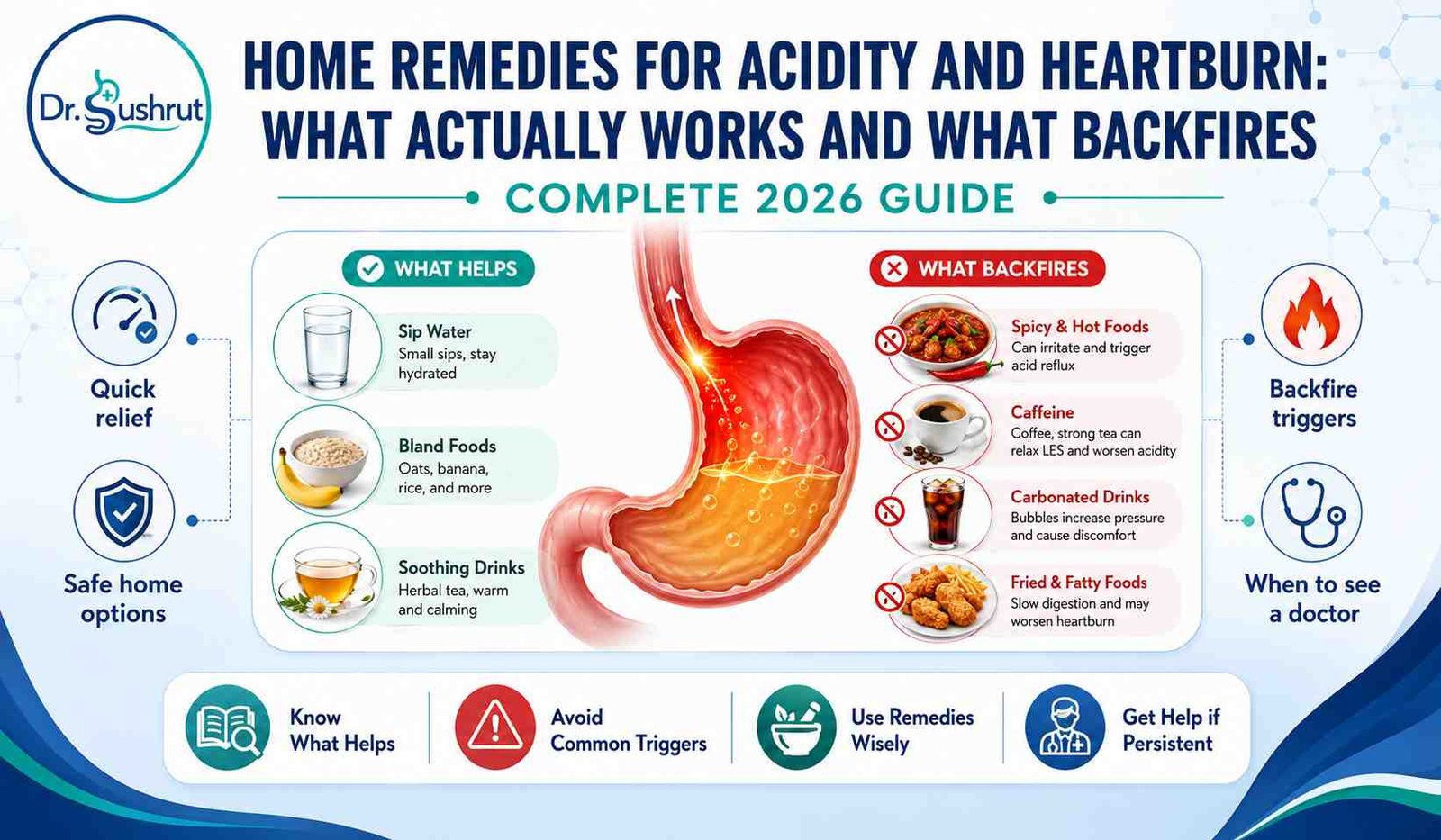
Nearly everyone reaches for a home remedy at the first burn behind the breastbone. Cold milk. A spoon of ajwain. Ginger tea. Baking soda in water. Some of these calm symptoms within minutes. Others quietly worsen the underlying reflux and set the stage for years of unnecessary suffering. According to the Global Burden of Disease Study published in The Lancet Gastroenterology & Hepatology, GERD affected over 780 million people globally in 2017 with prevalence continuing to rise in India, driven by dietary shifts and rising obesity rates.
This guide separates acidity home remedies into two clear categories: what genuinely helps and what may feel soothing but actively backfires. Written from a specialist gastroenterology perspective, it will help you understand which remedies to try first, which to avoid, and when home management is no longer enough.
Key Takeaways
- Cold milk offers short-term relief but rebound acidity within 2-3 hours is common
- Baking soda works fast but disrupts sodium balance and worsens reflux with regular use
- Chewing sugar-free gum after meals is one of the most underrated evidence-backed remedies
- Ajwain, saunf, and jeera water help mild acidity but do not treat structural reflux
- Persistent heartburn beyond 2 weeks despite home remedies needs specialist evaluation
What Acidity and Heartburn Actually Are
Acidity is the sensation caused when stomach acid moves upward into the esophagus (food pipe). This happens because the muscular valve between the stomach and esophagus, called the lower esophageal sphincter, relaxes when it should stay closed. Heartburn is the burning sensation this causes, typically felt behind the breastbone. When this happens more than twice a week, the condition is diagnosed as gastroesophageal reflux disease (GERD).
Most Indian patients confuse acidity with gastritis or ulcer, and self-medicate for years without addressing the mechanical reflux causing the problem. Understanding the difference is the first step to picking the right remedy.
Home Remedies Fact-Check: What Works vs What Backfires
| Home Remedy | What It Actually Does | Verdict |
|---|---|---|
| Cold milk | Buffers acid briefly; fat content triggers rebound acid | Short-term relief only |
| Baking soda water | Neutralizes acid fast; sodium overload and rebound | Not safe for regular use |
| Ajwain (carom seeds) water | Mild digestive stimulant; reduces gas | Safe, mildly helpful |
| Saunf (fennel) after meals | Calms gastric mucosa; reduces bloating | Safe, genuinely helpful |
| Jeera (cumin) water | Improves gastric emptying | Safe, helpful |
| Ginger tea (small amounts) | Anti-inflammatory; may reduce nausea | Safe in moderation |
| Coconut water | Alkaline pH; hydrates esophagus | Safe, moderately helpful |
| Sugar-free gum after meals | Increases saliva; clears acid from esophagus | Underrated, highly effective |
| Apple cider vinegar | Popular myth; adds acid to already acidic stomach | Actively harmful |
| Amla juice on empty stomach | Vitamin C load worsens reflux in sensitive patients | Backfires often |
| Tulsi leaves in excess | Blood-thinning effect; stimulates acid | Use very sparingly |
| Peppermint tea | Relaxes the sphincter valve; worsens reflux | Counterproductive |
| Chocolate or mint after meals | Both relax the LES sphincter | Trigger foods |
The centerpiece insight here is column three. Many remedies popular in Indian households feel soothing in the moment because of temperature (cold milk), texture (banana), or ritual (herbal tea). That short-term comfort masks whether the remedy is actually reducing reflux frequency over weeks. If you have been managing acidity with any red-marked remedy for months and symptoms keep returning, you likely need proper evaluation from a specialist gastroenterologist in Gaur City Greater Noida rather than a stronger version of the same failing remedy. Reflux that resists home management often points to a valve mechanics issue that food cannot fix.
The Remedies That Actually Reduce Reflux Frequency
Post-meal walking (10-15 minutes): The most underused acidity intervention. Walking supports gastric emptying and lowers meal-triggered reflux by up to 40 percent.
Elevating the head of the bed by 6-8 inches: The entire torso must be inclined, not just the neck on pillows. This reduces nocturnal heartburn significantly.
Sugar-free chewing gum for 30 minutes after meals: Saliva is naturally alkaline and clears refluxed acid. This is a well-evidenced non-drug intervention.
Smaller meals and slower eating: A full stomach generates more pressure against the sphincter. Two smaller meals work better than one large one.
No lying down for 3 hours after eating: Dinner at 9 PM followed by sleep at 10 PM guarantees nightly reflux.
What Backfires and Why
Baking soda: Rapid neutralization causes rebound acid production. Sodium load also raises blood pressure over time.
Apple cider vinegar: Adding acid to an already acidic stomach worsens reflux in most Indian patients.
Amla, lemon water, tamarind, pickle: All acidic foods marketed as digestive aids. In a patient with a weak sphincter, they worsen the problem.
Peppermint and chocolate: Both relax the sphincter valve directly. Peppermint feels soothing to the throat while making reflux worse.
Late-night ghee or milk: Both take hours to leave the stomach and cause overnight reflux.
If home remedies have not brought lasting relief within two to three weeks, an evaluation is warranted. Persistent acidity that needs regular antacids typically indicates GERD that will not resolve without proper treatment. Getting a clear diagnostic workup and understanding the acidity and GERD treatment cost in Noida helps set realistic expectations before you consult. Most cases are manageable with lifestyle changes plus a short course of proton pump inhibitors, but some cases point to structural issues like hiatal hernia that need proper imaging to identify.
💬 Not Sure If Your Acidity Is GERD or Just Occasional?
If home remedies have not worked, or you are taking antacids more than twice a week, a specialist consultation with Dr. Sushrut Singh (DM Gastroenterology) can identify whether your acidity is a lifestyle-triggered issue, GERD, or something more serious like H. pylori infection or hiatal hernia.
When Home Remedies Are Not Enough: Red Flags
| Warning Sign | What It Might Indicate | Action Needed |
|---|---|---|
| Heartburn 2+ times weekly for 4+ weeks | GERD | Specialist consultation |
| Difficulty swallowing or food sticking | Esophagitis or stricture | Endoscopy needed |
| Unintentional weight loss | Ulcer or serious pathology | Urgent evaluation |
| Vomiting blood or black stools | Bleeding ulcer | Emergency care |
| Persistent cough or hoarseness | Silent reflux | Full workup |
Any of these means home remedies have gone as far as they can. The right workup usually starts with a diagnostic upper GI endoscopy in Gaur City Greater Noida to examine the esophagus and stomach directly. Endoscopy can rule out serious causes within 15-20 minutes and gives clarity that no home remedy or antacid can offer. In most patients with straightforward reflux, one endoscopy plus a targeted treatment plan resolves years of ongoing discomfort.
Future Trends in Acidity Management
The management of chronic acidity in India is moving toward earlier endoscopy in symptomatic patients rather than years of empirical antacid use. New minimally invasive procedures like LINX and endoscopic fundoplication are becoming available in select Indian centers, offering alternatives to lifelong medication. Home care will increasingly shift toward personalized dietary trigger identification through food diaries and app-based tracking rather than generic advice.
Conclusion
Not all home remedies for acidity are equal. Some genuinely reduce reflux frequency (post-meal walking, sugar-free gum, head-of-bed elevation, meal timing), some offer temporary relief without addressing the cause (cold milk, ajwain water), and some actively worsen the underlying problem (apple cider vinegar, peppermint, baking soda for daily use). The most useful step is not finding a stronger remedy but understanding whether your acidity is a lifestyle issue that food can fix or a mechanical reflux problem that needs specialist evaluation. If heartburn persists despite two to three weeks of the safe remedies above, please consult a gastroenterologist.
🧪 The 7-Day Acidity Cause Self-Check
Before assuming your acidity is “just diet,” run this simple 7-day audit:
- Day 1-2: Track exactly when heartburn appears (within 30 min of a meal? 2 hours after? Only at night?)
- Day 3-4: Remove peppermint, chocolate, mint tea, and late-night meals. Note change.
- Day 5-6: Add post-meal 10-minute walks and sugar-free gum. Note change.
- Day 7: Elevate head of bed. Note overnight symptoms.
If symptoms persist after all four steps, the cause is not diet alone. Book an evaluation.
📍 Book Consultation at Either Location
|
Gaur City Clinic Greater Noida West 📞 Call: +91 93153 54431 💬 WhatsApp Now 📍 View on Google Maps |
Fortis Hospital Sector 62 📞 Call: +91 93153 54431 💬 WhatsApp Now 📍 View on Google Maps |
Frequently Asked Questions
Is cold milk actually bad for acidity?
Cold milk is not bad for occasional acidity, but relying on it regularly is problematic. The calcium and protein initially buffer stomach acid and give quick relief. However, the fat content triggers rebound acid production within 2-3 hours, meaning acidity often returns worse than before. Skim milk or plain water works better for regular use, and a walk after meals reduces the need for any liquid remedy.
How long should I try home remedies before seeing a specialist?
If you are taking antacids or reaching for home remedies more than twice a week for more than 2-3 weeks, it is time for a specialist consultation. Continuing to self-manage beyond this window means you may be missing a treatable underlying condition like H. pylori infection, hiatal hernia, or esophagitis, and delayed diagnosis can lead to complications like Barrett’s esophagus over time.
Are Ayurvedic remedies safe for chronic acidity?
Individual ingredients like ajwain, saunf, and jeera are safe in small quantities. However, many packaged Ayurvedic acidity preparations contain multiple herbs whose interactions have not been well studied, and some contain herbs like liquorice that raise blood pressure with long-term use. If chronic acidity requires ongoing management, a specialist evaluation gives more reliable and safer outcomes than self-prescribed herbal combinations.