
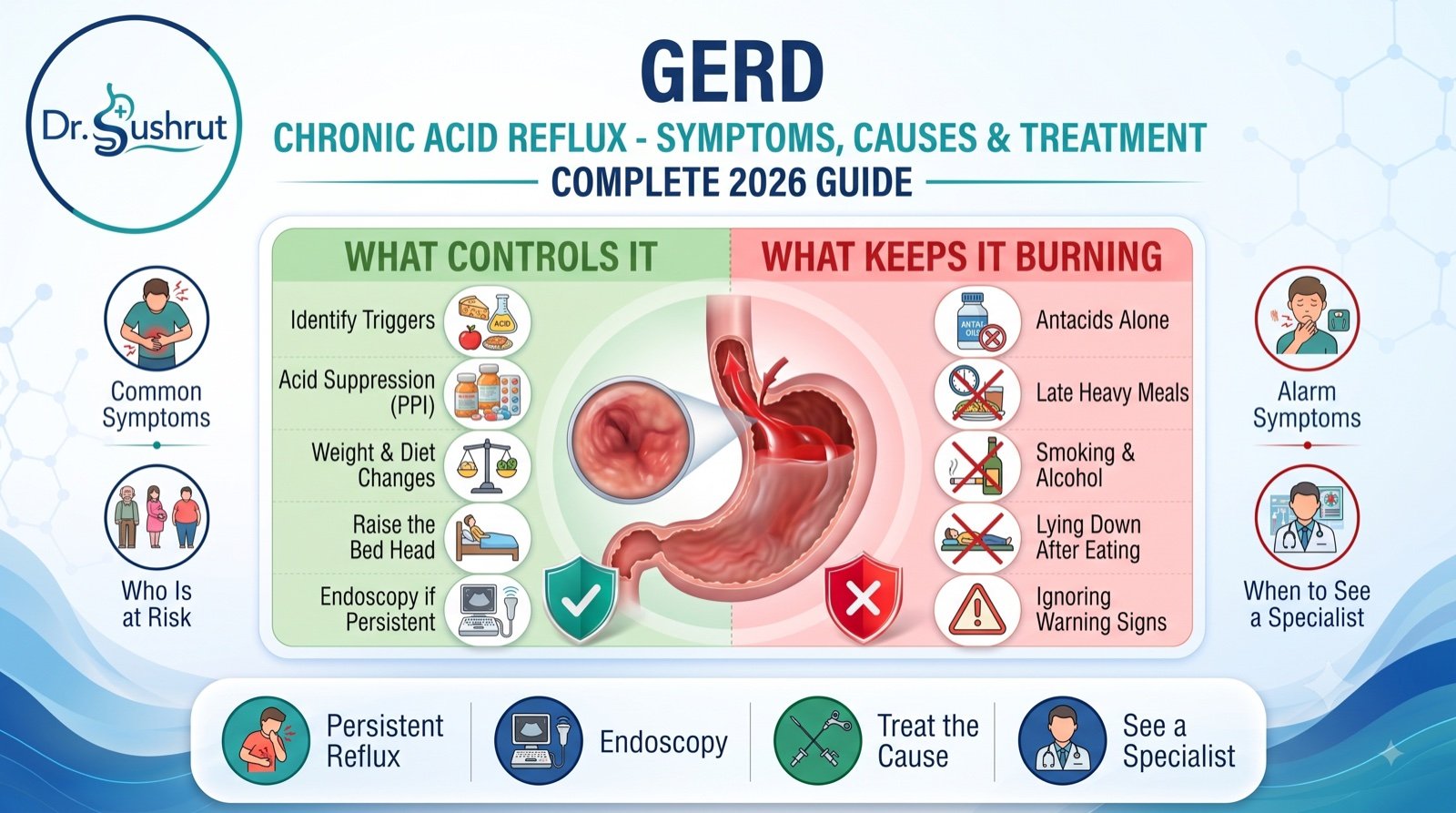
Almost everyone gets heartburn now and then, but when that burning behind the breastbone comes back several times a week, brings acid or food up into the throat, or wakes you at night, it has stopped being simple acidity and become a condition called GERD. It is one of the most common digestive complaints in India, and also one of the most misunderstood – treated for years with a strip of antacids when the real problem is a mechanical one that antacids cannot fix. You can read a clear medical overview at the US National Institute of Diabetes and Digestive and Kidney Diseases.
This guide, written to reflect how a DM Gastroenterology specialist assesses acid reflux, explains what GERD actually is, why it happens, the symptoms and warning signs, and how it is treated so the reflux is controlled rather than just briefly numbed.
Key Takeaways
- GERD (gastro-oesophageal reflux disease) is frequent acid reflux that irritates the food pipe, not the occasional heartburn everyone gets.
- It happens when the valve between the stomach and food pipe weakens and lets acid flow back up.
- Typical symptoms are a burning chest, a sour taste, regurgitation, and a cough or throat irritation that is worse when lying down.
- Difficulty swallowing, weight loss or vomiting blood are warning signs that need urgent endoscopy.
- Treatment combines lifestyle changes with acid-suppressing medicine; untreated GERD can damage the food pipe over time.
What is GERD?
Between the food pipe and the stomach sits a ring of muscle that should open to let food down and then close to keep acid in. In GERD, that valve does not close properly, so stomach acid washes back up into the food pipe, where the delicate lining is not built to withstand it.
GERD (gastro-oesophageal reflux disease) – a condition in which the valve at the top of the stomach allows acid to flow back into the food pipe repeatedly, causing symptoms or damage. It differs from ordinary heartburn by being frequent and persistent rather than an occasional event.
This is why GERD does not respond for long to antacids: they neutralise a single wave of acid but do nothing about the faulty valve or the frequency of reflux. Many people cycle through home remedies for months before realising the pattern, when the acidity and heartburn keep coming back is itself the clue that this is GERD rather than one-off indigestion.
Symptoms of GERD
GERD shows up in more ways than most people expect, and not all of them feel like classic heartburn:
- A burning feeling in the chest, often after meals and worse when lying down or bending over.
- A sour or bitter taste, or the sensation of food and acid coming back up (regurgitation).
- A chronic dry cough, throat clearing, hoarseness or the feeling of a lump in the throat.
- Disturbed sleep from night-time reflux, and sometimes worsening of asthma symptoms.
Because the cough and throat symptoms do not obviously point to the stomach, GERD is often missed and treated as a throat or chest problem for months.
Warning signs that need urgent assessment
See a specialist promptly if reflux comes with any of these
Difficulty or pain when swallowing, or food sticking
Unintended weight loss
Vomiting blood, or black, tarry stool
Persistent vomiting, or symptoms that started for the first time after age 45These are alarm features that call for an endoscopy to look at the food pipe directly, rather than simply prescribing more acid medicine.
What causes and worsens GERD
GERD develops when the anti-reflux valve is weak or under pressure, and several everyday factors make it worse. Being overweight, especially around the abdomen, pushes stomach contents upward, and a hiatus hernia – where part of the stomach slips above the diaphragm – undermines the valve directly. Large or late meals, lying down soon after eating, smoking, alcohol, and very oily or spicy food all provoke reflux, as does pregnancy through pressure and hormonal changes. Identifying which of these apply to a given person is central to bringing the condition under control, because removing the triggers often does as much as medication.
How GERD is diagnosed
Typical GERD is often diagnosed from the symptoms and a trial of treatment. When symptoms persist, are severe, or come with any alarm feature, an upper GI endoscopy is done to inspect the food pipe for inflammation or complications and to rule out other causes. Occasionally, specialised tests that measure acid exposure and the muscle function of the food pipe are used when the diagnosis is unclear or surgery is being considered.
| Test | What it shows | When it is used |
|---|---|---|
| Symptom-based diagnosis | Typical reflux pattern responding to treatment | Common, uncomplicated GERD |
| Upper GI endoscopy | Inflammation, a hernia or complications in the food pipe | Persistent, severe or alarm-feature cases |
| Acid and motility studies | How much acid refluxes and how the food pipe moves | Unclear diagnosis or before surgery |
Treatment: controlling reflux for good
Treatment works best when lifestyle change and medicine go together. The everyday measures do a great deal: losing excess weight, eating smaller and earlier meals, not lying down for two to three hours after eating, raising the head of the bed, and cutting down smoking and alcohol. On top of this, an acid-suppressing medicine (usually a proton-pump inhibitor) heals the irritated food pipe and controls symptoms, taken for a defined course and then reviewed rather than continued indefinitely without thought. Where reflux is severe, driven by a large hiatus hernia, or does not respond, a specialist may discuss a surgical procedure to reinforce the valve. Because long-standing untreated reflux can scar or change the lining of the food pipe, persistent symptoms are worth a proper evaluation rather than an endless supply of antacids – it is sensible to have ongoing reflux assessed rather than self-treating for years.
| Approach | Pros | Cons |
|---|---|---|
| Lifestyle change plus acid suppression | Controls symptoms and heals the food pipe | Needs consistency and review of the medicine |
| Antacids alone | Quick, brief relief of a flare | Does not address the faulty valve; symptoms return |
| Anti-reflux surgery | Can give lasting control in selected cases | Reserved for severe or hernia-related GERD |
Future trends in GERD care
Reflux care is moving toward a more tailored approach. Newer, longer-acting acid-blocking medicines are improving control for stubborn cases, and minimally invasive endoscopic and keyhole procedures are giving people with severe reflux an alternative to open surgery. There is also a stronger focus on identifying who truly needs long-term medication versus who can manage with lifestyle change alone, and on monitoring the small number of people whose long-standing reflux changes the lining of the food pipe. The theme is precision: matching the intensity of treatment to the individual.
Conclusion
GERD is common, treatable, and quite different from the occasional heartburn it is often mistaken for. Because it is driven by a faulty valve rather than a single burst of acid, it responds to a combination of lifestyle change and the right medicine far better than to antacids alone. If reflux, a sour taste or a night-time cough keeps returning several times a week – and especially if swallowing becomes difficult – it is worth having it properly assessed.
Heartburn or acid reflux that keeps coming back week after week?
Dr. Sushrut Singh, a DM Gastroenterology specialist, assesses the cause of reflux, checks the food pipe with endoscopy when it is needed, and builds a plan that controls GERD rather than just masking it. Consultations are at the Gaur City clinic in Greater Noida West, with endoscopy available at Fortis Hospital, Sector 62.
Call or WhatsApp +91 93153 54431 to have your reflux assessed. Lasting relief comes from treating the cause.
Frequently Asked Questions (FAQs)
What is the difference between heartburn and GERD?
Heartburn is an occasional symptom that most people get sometimes. GERD is frequent, persistent acid reflux – usually several times a week – that can irritate or damage the food pipe and needs proper treatment.
Can GERD be cured permanently?
Many people control GERD fully with lifestyle changes and medication, and some with a weak valve or hernia benefit from surgery. Whether it is fully cured depends on the cause, but symptoms can almost always be well controlled.
Is it safe to take acid-reducing medicines long term?
They are effective and generally safe when used appropriately, but they should be taken at the right dose for a reviewed period rather than indefinitely without assessment. A specialist can decide who needs long-term treatment.
Can GERD cause a cough or sore throat?
Yes. Acid reaching the throat can cause a chronic cough, hoarseness, throat clearing or a lump-like sensation, which is why GERD is sometimes mistaken for a throat or chest problem.
When should I get an endoscopy for reflux?
An endoscopy is advised if reflux is persistent or severe, does not respond to treatment, starts for the first time after age 45, or comes with difficulty swallowing, weight loss or bleeding.