
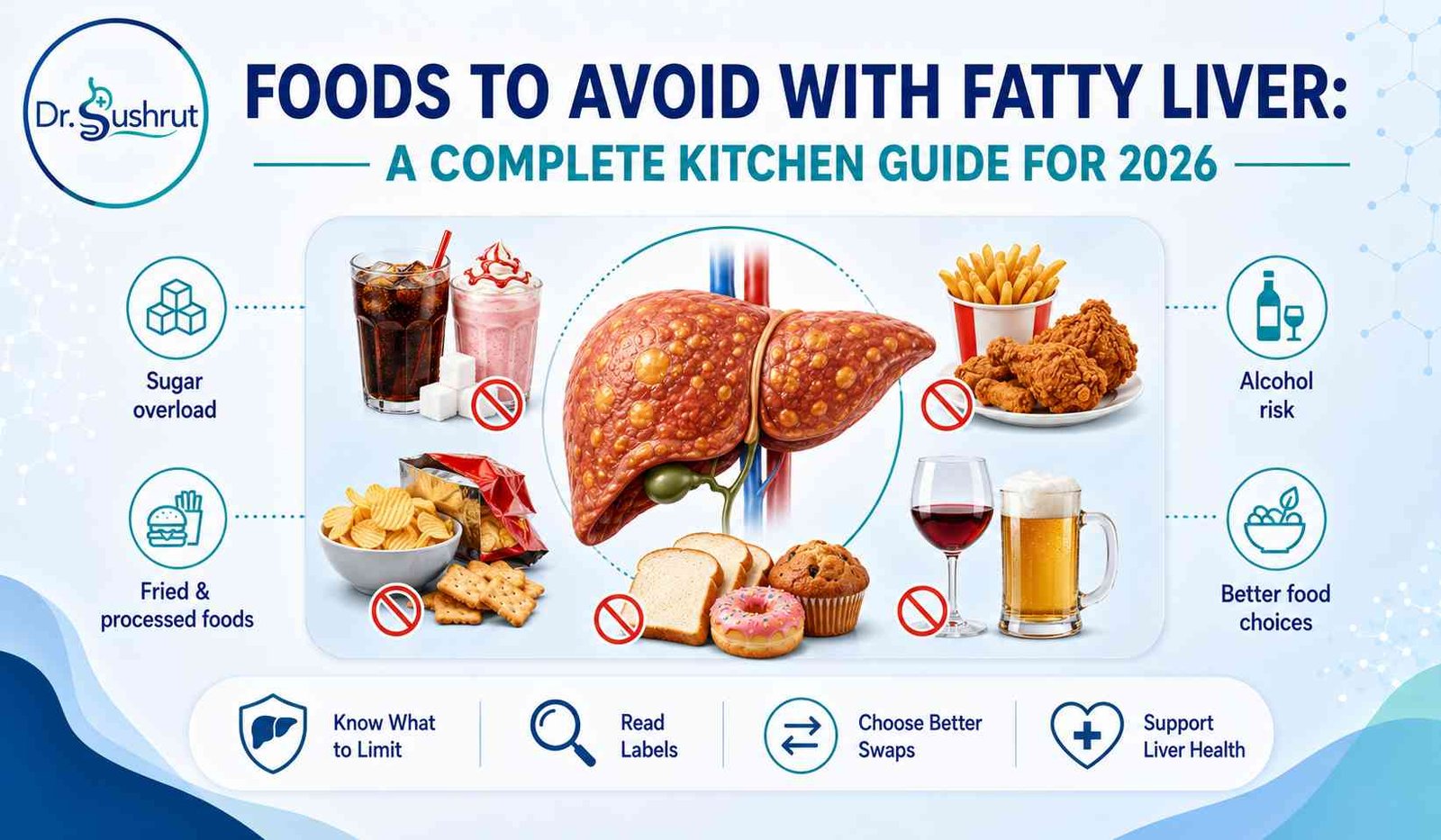
If your recent ultrasound came back saying “grade I or II fatty liver,” you probably left the clinic with a vague piece of advice: eat healthy, exercise more. That is not a plan. It is a prescription for confusion and, eventually, disease progression. According to the Indian National Association for Study of the Liver (INASL) Guidance Paper on NAFLD, non-alcoholic fatty liver disease now affects nearly one in three urban Indian adults, driven largely by everyday dietary patterns that most families consider normal.
This guide is a specialist-authored kitchen list. It tells you what to remove from your kitchen entirely, what to reduce, what to keep, and what to add. The focus is on foods common in Indian homes rather than generic Western diet advice that does not translate. If you follow this consistently for 12 weeks, most early-stage fatty liver improves measurably.
Key Takeaways
- Refined carbs like maida, sugar, and processed rice drive fatty liver more than dietary fat itself
- Fructose from fruit juices and processed foods is the single worst ingredient for the liver
- “Healthy” foods like sweetened lassi, ghee-heavy sweets, and namkeen are common hidden triggers
- Dal, sabzi, roti, and curd in moderate portions are safe for fatty liver
- 5-7 percent body weight loss over 6 months reverses most early-stage fatty liver
What Fatty Liver Actually Is
Fatty liver, medically called hepatic steatosis, means fat has accumulated inside liver cells. Non-alcoholic fatty liver disease (NAFLD) is the version caused by metabolic factors like insulin resistance rather than alcohol. When fat exceeds 5 percent of liver weight, it is diagnosed as fatty liver. Left untreated, it can progress to inflammation (NASH), scarring (fibrosis), and eventually cirrhosis. Diet is the most powerful lever for reversing early-stage fatty liver.
The tricky part is that fatty liver is silent. Most patients feel completely fine while their liver quietly deteriorates over 5-10 years. By the time symptoms appear, the disease has often progressed.
The Foods to Cut Completely
| Food Category | Specific Items | Why It Harms |
|---|---|---|
| Refined carbs | Maida, biscuits, white bread, samosa, kachori | Rapid glucose spike drives liver fat storage |
| Sugary drinks | Cola, packaged juices, sweetened lassi, energy drinks | Fructose converts directly to liver fat |
| Fried snacks | Bhujia, chips, pakora, samosa (deep fried) | Trans fats increase liver inflammation |
| Sweets in excess | Gulab jamun, jalebi, barfi, kheer | Combined sugar and ghee load hits liver twice |
| Processed meats | Salami, sausages, packaged kebabs | Nitrates plus saturated fat worsen NAFLD |
| Alcohol | All types, including “light” beer and wine | Direct liver toxicity, even in small amounts |
| Bakery items | Cakes, pastries, cream biscuits, puff | Refined flour plus sugar plus trans fat |
| Refined oils in excess | Palm oil, vanaspati, reused frying oil | Oxidized fats worsen liver inflammation |
The centerpiece insight is that most dietary “villains” in fatty liver are not what patients expect. It is not roti or dal or paneer. It is refined carbs, sugary drinks, and packaged snacks that dominate modern urban Indian meals. If you have been diagnosed with grade I or II fatty liver and your family diet includes daily biscuit-chai, weekend sweets, and children’s cola culture, those must be addressed before any advanced treatment or supplement. A proper baseline assessment using FibroScan in Gaur City Greater Noida can give you a numerical liver stiffness value against which future improvements can be measured, so you know if your dietary changes are actually reversing the disease.
The Foods to Reduce (Not Eliminate)
Ghee and desi cow butter: A common source of confusion. In moderation (1-2 teaspoons daily), ghee is not harmful for fatty liver. The problem starts at 4-5 tablespoons daily as is common in many North Indian households. Measure your intake.
White rice and refined atta: Not toxic, but should be reduced to one meal a day. Switch to hand-pounded rice, brown rice, or millet-mix flour for other meals.
Curd and dahi: Full-fat versions are fine. Sweetened lassi and mishti dahi are not because of added sugar.
Ripe fruits: Bananas, mangoes, and chikoo have high fructose. Two servings a day maximum. Berries and citrus are better choices.
Nuts: Almonds, walnuts, and pistachios are protective in fatty liver but calorie-dense. Stick to a small handful daily rather than a bowl.
Refined salt: High salt intake worsens insulin resistance. Aim for less than 5 grams daily (about one teaspoon total across the day).
Paneer: Not harmful in moderation, but many Indian families eat paneer daily as a “healthy protein.” Full-fat paneer is calorie-dense and can slow fatty liver reversal. Limit to 2-3 times weekly, or use tofu as an alternative.
Full-fat dairy: Milk itself is fine, but adding cream, malai, or full-cream milk to every meal adds unnecessary saturated fat. Toned milk is the sensible middle ground for daily use.
Understanding what a full clinical fatty liver reversal program looks like, including cost, timelines, and monitoring, matters just as much as knowing what to eat. The fatty liver treatment cost in Noida varies based on stage and monitoring needs. Knowing this upfront helps you plan a proper 6-month reversal journey rather than one-off appointments driven by symptoms.
💬 Wondering If Your Fatty Liver Is Reversible?
Grade I and II fatty liver is almost always reversible with the right diet and lifestyle plan. Dr. Sushrut Singh (DM Gastroenterology) can assess your liver stiffness, review your diet, and give you a personalized 12-week reversal plan.
The Foods That Actively Help the Liver
Green leafy vegetables: Palak, methi, sarson, bathua. Choline and fiber support liver fat clearance. Aim for one to two servings daily.
Whole dals: Moong, masoor, arhar, and rajma in normal portions. Protein without excess saturated fat.
Coffee (unsweetened): One of the well-documented protective agents for the liver. 2-3 cups daily reduces fibrosis risk.
Green tea: Similar catechin-driven benefits. 2 cups daily is sufficient.
Fish (grilled or curried, not fried): Omega-3 content reduces liver inflammation. Rohu, hilsa, salmon 2-3 times weekly.
Whole grains: Bajra, jowar, ragi, oats. Slow-release carbs that do not spike insulin.
Turmeric: Curcumin has genuine anti-inflammatory effects. Use liberally in cooking. Supplements are not necessary.
Meal Pattern Matters as Much as Food Choice
Skipping breakfast worsens fatty liver: This surprises most patients. Long fasting between dinner and lunch spikes cortisol and worsens insulin resistance. Eat breakfast within 90 minutes of waking.
Late-night dinners are a major driver: Eating past 9 PM gives insulin no chance to clear before sleep. Aim to finish dinner by 8 PM.
Snacking between meals worsens NAFLD: Every eating episode releases insulin. Constant insulin secretion drives fat storage. Stick to 3 structured meals with no snacking.
Intermittent fasting works for many patients: A 14-hour overnight fast (8 PM to 10 AM) reduces liver fat within 8-12 weeks in most patients without medication.
Alongside dietary changes, recognizing the symptoms of fatty liver disease matters because progression often happens silently. Fatigue, dull right-upper-abdomen ache, and rising liver enzymes on routine tests are early warnings that need specialist evaluation and imaging beyond ultrasound.
Future Trends in Fatty Liver Management
Fatty liver treatment in India is moving toward earlier diagnosis with FibroScan rather than waiting for symptoms, and precision nutrition based on individual metabolic profiles rather than generic diet charts. New medications like resmetirom (approved for NASH in the US) may become available in India in the next 2-3 years. However, dietary and lifestyle changes will remain the foundation of treatment because they address the underlying cause rather than just controlling symptoms.
Conclusion
The foods to avoid with fatty liver are not obscure or exotic. They are the refined carbs, sugary drinks, and packaged snacks that dominate modern urban Indian meals. The foods that help are the traditional whole foods that Indian kitchens have used for centuries: dals, sabzis, whole grains, and moderate healthy fats. If you have been diagnosed with grade I or II fatty liver, the disease is almost always reversible with 12-24 weeks of consistent dietary change. Get a baseline liver stiffness measurement so you can track progress objectively.
🍽️ The Fatty Liver Fridge Audit
Open your fridge and pantry right now. Do this 3-column audit:
|
🔴 Throw Out Cola, packaged juices, sweetened lassi, cream biscuits, salted namkeen packets, refined oil, maida, sugary breakfast cereals |
🟡 Ration Ghee (measured teaspoons), white rice, curd (unsweetened only), bananas, refined salt |
🟢 Stock More Palak, methi, moong, oats, bajra flour, walnuts, coffee, green tea, turmeric, fish |
Do this once and your kitchen becomes your treatment plan.
📍 Book Consultation at Either Location
|
Gaur City Clinic Greater Noida West 📞 Call: +91 93153 54431 💬 WhatsApp Now 📍 View on Google Maps |
Fortis Hospital Sector 62 📞 Call: +91 93153 54431 💬 WhatsApp Now 📍 View on Google Maps |
Frequently Asked Questions
Can I still eat ghee if I have fatty liver?
Yes, in moderation. One to two teaspoons of pure desi ghee daily is not harmful for fatty liver, and may actually help in small quantities. The problem is when ghee is used at 4-5 tablespoons daily as part of paranthas, dals, and sweets combined. Measure your intake using teaspoons rather than eyeballing, and switch to olive oil or mustard oil as the primary cooking fat.
Is intermittent fasting safe for fatty liver patients?
Yes, a 14-hour overnight fast is generally safe and often helpful for early-stage fatty liver. Eating dinner by 8 PM and breakfast at 10 AM gives the liver 14 hours to clear fat and lets insulin drop. However, extreme fasting protocols like 24-hour fasts are not recommended without specialist supervision, particularly if you are diabetic or on medications.
How quickly can fatty liver reverse with dietary changes?
Measurable improvement typically appears within 8-12 weeks of consistent dietary and lifestyle changes. A FibroScan or ultrasound at 12 weeks usually shows reduced liver fat if compliance has been good. Full reversal of grade II fatty liver often takes 6-9 months. The critical factor is consistency, not perfection. Small daily choices matter more than occasional strict weeks followed by relapses.