
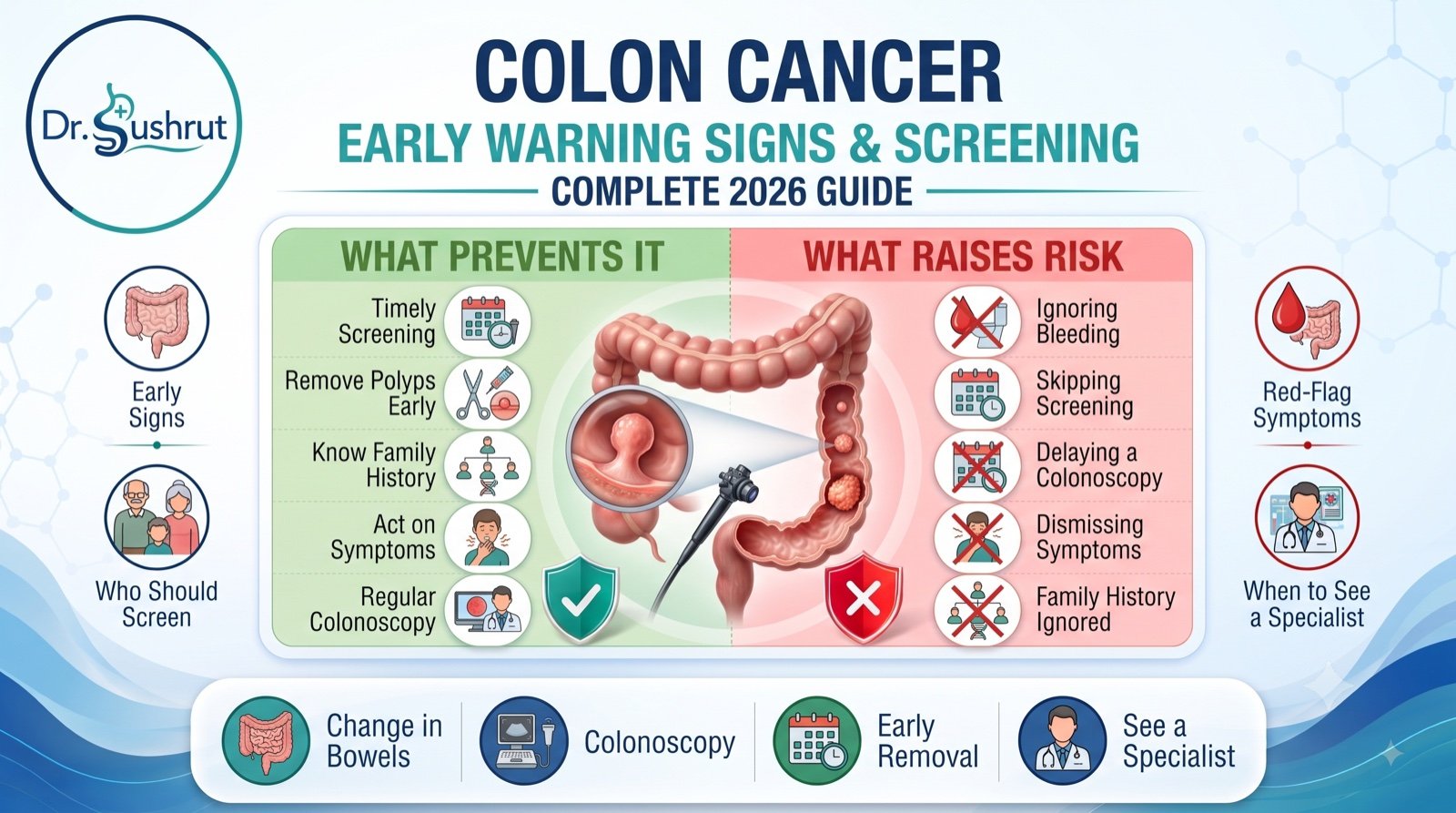
Colon cancer is one of the few serious cancers that can often be prevented outright, because it usually begins as a small, harmless growth called a polyp that takes years to turn dangerous – and a colonoscopy can find and remove that polyp long before it ever becomes cancer. The catch is that early colon cancer is usually silent, and its first symptoms are easy to blame on piles or a passing stomach problem. Understanding the early warning signs and who should be screened is genuinely life-saving. A clear overview is available from the US National Cancer Institute.
This guide, written to reflect how a DM Gastroenterology specialist approaches bowel symptoms and screening, explains the early warning signs, who is at risk, when screening should start, and why a colonoscopy is both the test and, often, the cure.
Key Takeaways
- Most colon cancers start as a polyp – a small growth that can be removed during colonoscopy before it ever turns cancerous.
- Early colon cancer often has no symptoms, which is why screening matters even when you feel well.
- Warning signs include a lasting change in bowel habit, blood in the stool, unexplained weight loss and persistent abdominal discomfort.
- Rectal bleeding should never be assumed to be “just piles” without assessment.
- A colonoscopy is the most reliable test and can remove polyps in the same sitting, making it both diagnosis and prevention.
What is colon cancer?
Colon cancer, also called colorectal cancer, develops in the large intestine or rectum. Its defining feature – and its great weakness – is that it almost always grows slowly from a pre-cancerous polyp, giving a long window in which it can be caught and stopped.
Colon (colorectal) cancer – cancer of the large intestine or rectum that usually begins as a benign polyp and turns malignant over several years. Because of that slow, predictable path, it is one of the most preventable and, when caught early, most treatable cancers.
That slow progression is exactly why screening works so well: removing a polyp during a routine colonoscopy prevents the cancer from ever forming. It is a rare instance where a single test can both diagnose a problem and cure it in the same visit.
Early warning signs
Early colon cancer is often silent, but when symptoms do appear they should not be ignored:
- A lasting change in bowel habit – new constipation, looser stools, or a narrower stool – persisting beyond a few weeks.
- Blood in the stool, whether bright red or dark, or a persistently black stool.
- A feeling that the bowel does not empty completely, or ongoing cramping and abdominal discomfort.
- Unexplained weight loss, persistent tiredness, or low iron (anaemia) found on a blood test.
These symptoms have many harmless causes too, but the point is not to panic – it is to get them checked rather than assume the innocent explanation.
Do not assume rectal bleeding is “just piles”
Get assessed, do not self-diagnose, if you have
Blood in the stool at any age, even if you have piles
A change in bowel habit lasting more than a few weeks
Unexplained weight loss or unexplained anaemia
A strong family history of bowel cancer or polypsPiles and colon cancer can cause identical bleeding. The only safe way to tell them apart is an examination, not an assumption.
Because the symptoms overlap, bleeding that is put down to piles without any examination is one of the commonest ways an early bowel cancer is missed.
Who should be screened, and when
Screening is offered to people before they have symptoms, precisely because early disease is silent. For those at average risk, screening is generally recommended from around the age of 45 to 50. It should start earlier, and be repeated more often, for anyone with a close relative who has had bowel cancer or polyps, a personal history of polyps, or long-standing inflammatory bowel disease. Anyone who develops the warning symptoms above, at any age, should be assessed regardless of screening schedules. The right starting age and interval are best decided with a specialist based on personal and family risk.
How it is diagnosed and screened
Several tests are used, but one stands above the rest because it both looks and treats. A colonoscopy examines the entire large bowel and allows any polyp to be removed and any suspicious area to be biopsied in the same sitting. Stool-based tests that check for hidden blood are simpler and can be a first step, but a positive result still needs a colonoscopy to investigate. Where cancer is confirmed, scans are used to assess its extent and plan treatment.
| Test | What it does | Role |
|---|---|---|
| Colonoscopy | Views the whole large bowel and removes polyps | The gold standard – screens, diagnoses and prevents |
| Stool test for hidden blood | Detects blood not visible to the eye | A simple first step; a positive result needs colonoscopy |
| Scans (CT and others) | Show the extent of a confirmed cancer | To stage the disease and plan treatment |
Treatment and outlook
The outlook for colon cancer depends heavily on how early it is found, which is the whole argument for screening. A polyp removed at colonoscopy needs nothing further. Cancer caught at an early stage is often treated successfully with surgery alone, while more advanced disease may also need chemotherapy or radiotherapy, planned by a team of specialists. Caught early, colon cancer has a very good prognosis; caught late, it is far harder to treat – and the difference between those two situations is usually whether it was found through screening or only after symptoms appeared. Anyone with warning symptoms, or who is due for screening, should arrange an assessment rather than wait.
Future trends in colon cancer prevention
Prevention keeps improving. Better stool-based and other non-invasive tests are making it easier to identify who needs a colonoscopy, and higher-quality colonoscopy with improved detection – increasingly supported by artificial intelligence that helps spot small polyps – is catching more pre-cancerous growths. There is also growing awareness of colon cancer appearing in younger adults, which is prompting earlier attention to symptoms. The consistent message across all of it is unchanged: find and remove polyps early, and the cancer never gets the chance to develop.
Conclusion
Colon cancer is serious, but it is also one of the most preventable cancers there is, because it grows slowly from a polyp that a colonoscopy can remove. Early disease is silent, so screening at the right age matters even when you feel well – and any warning sign, especially blood in the stool, should be checked rather than explained away. Found early, it is highly treatable; prevented through screening, it never has to be treated at all.
Noticed a change in bowel habit, bleeding, or due for screening?
Dr. Sushrut Singh, a DM Gastroenterology specialist, assesses bowel symptoms, advises on the right screening for your age and family history, and performs colonoscopy to find and remove polyps before they become a problem. Consultations are at the Gaur City clinic in Greater Noida West, with colonoscopy available at Fortis Hospital, Sector 62.
Call or WhatsApp +91 93153 54431 to arrange screening or an assessment. Early is everything with colon cancer.
Frequently Asked Questions (FAQs)
What is usually the first sign of colon cancer?
There is often no early symptom at all, which is why screening matters. When signs do appear, a lasting change in bowel habit or blood in the stool are among the most common, and both should be checked.
At what age should colon cancer screening start?
For people at average risk, screening generally begins around 45 to 50. It should start earlier for those with a family history of bowel cancer or polyps, a personal history of polyps, or long-standing IBD. A specialist can advise on the right age for you.
Can a colonoscopy prevent colon cancer?
Yes. Because most colon cancers begin as polyps, removing those polyps during a colonoscopy stops the cancer from ever forming. That is what makes colonoscopy both a screening test and a genuine preventive procedure.
Is bleeding from the back passage always piles?
No. Piles are a common cause, but colon cancer can cause identical bleeding, and the two cannot be told apart without an examination. Any rectal bleeding should be assessed rather than assumed to be piles.
Does colon cancer run in families?
It can. Having a close relative with bowel cancer or polyps raises your risk and usually means starting screening earlier and repeating it more often. Tell your specialist about any family history so screening can be tailored.