
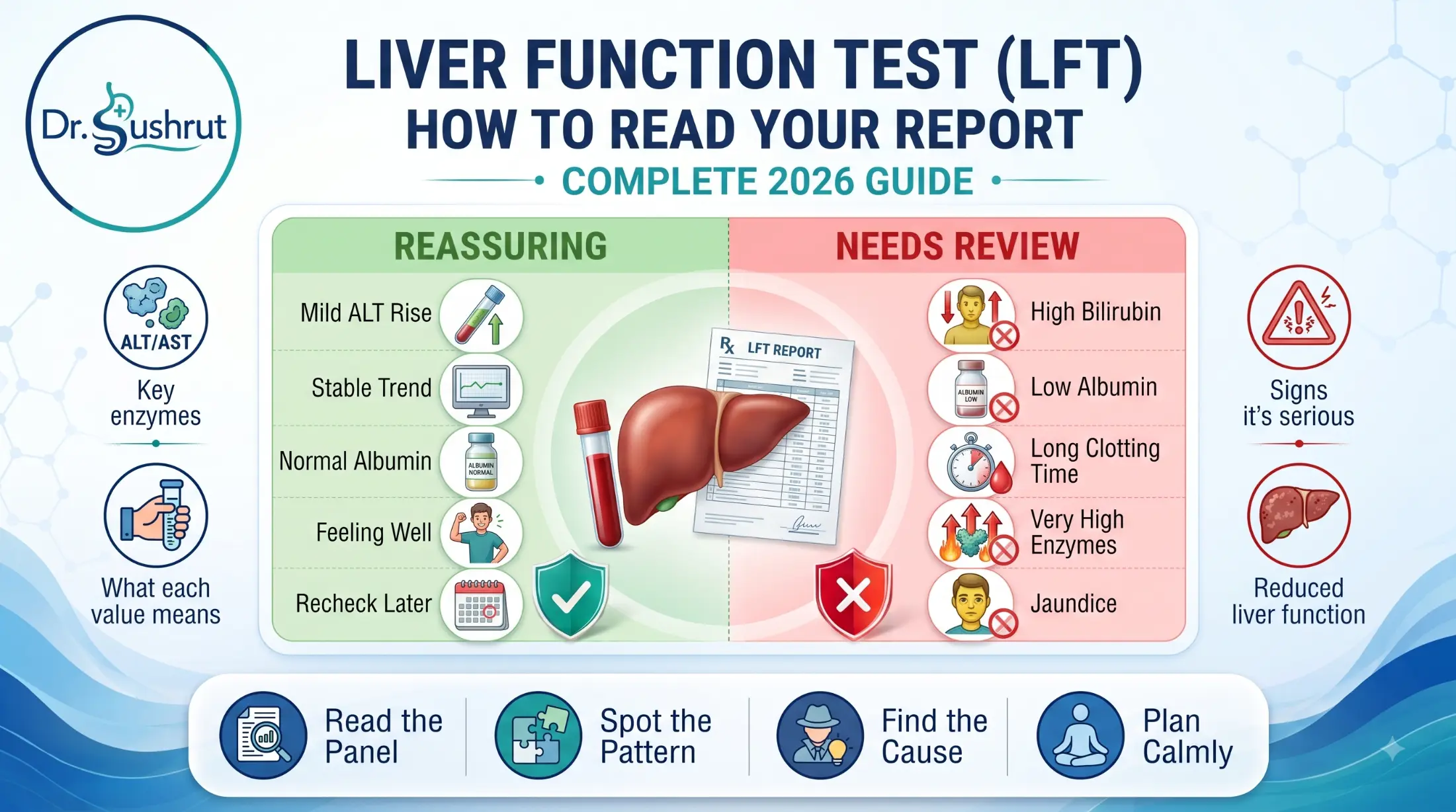
You get your blood report back, run your eye down the liver panel, and one or two values are printed in bold red. The heart sinks. Before it does, here is the reassuring part: mildly abnormal liver tests are extremely common – StatPearls notes that mild enzyme elevations are seen in roughly 10% to 20% of the general population – and most turn out to be manageable once someone explains what each number actually means.
Most lab reports hand you a wall of abbreviations with no context, and most online explainers either oversimplify or send you into a panic. This guide, written to reflect how a DM Gastroenterology specialist reads a liver panel, takes each value in turn, shows you the patterns that matter, and explains when a red figure is a genuine warning versus a routine, correctable finding.
Key Takeaways
- A liver function test (LFT) measures enzymes, bilirubin and proteins that together show how the liver is working and whether it is inflamed or blocked.
- The pattern across the values matters far more than any single high number.
- Mildly raised ALT and AST most often point to fat in the liver, not to serious disease.
- Albumin and the clotting time (PT/INR) reflect how well the liver is actually functioning, not just whether it is irritated.
- One abnormal report is a signal to investigate calmly, not a diagnosis on its own; the trend and the cause are what count.
What is a liver function test?
An LFT, also called a liver panel, is a group of blood tests that together give a snapshot of liver health rather than a single yes-or-no answer.
Liver function test (LFT) – a blood panel measuring liver enzymes (ALT, AST, ALP, GGT), bilirubin, and proteins (albumin, total protein), sometimes with the clotting time (PT/INR). Enzymes rise when liver cells are irritated; bilirubin and proteins show how well the liver is doing its actual work.
The name is slightly misleading. Some values (the enzymes) show damage or irritation, while others (albumin, clotting time) show genuine function. Reading them together is what separates a harmless finding from one that needs action. A quietly raised ALT with a normal everything-else is one of the most common results, and it usually traces back to early fatty liver changes rather than anything dramatic.
What each value means
Here is what the common entries on your report are telling you.
| Test | What it reflects | Raised suggests |
|---|---|---|
| ALT (SGPT) | Liver-cell irritation | Fatty liver, hepatitis, medicines |
| AST (SGOT) | Liver and muscle | Liver injury; also muscle or alcohol |
| ALP | Bile ducts and bone | Bile-flow blockage; also bone growth |
| GGT | Bile ducts, alcohol | Bile-duct issues, alcohol, some drugs |
| Bilirubin | Pigment the liver clears | Jaundice, blockage, breakdown of blood |
| Albumin | Protein the liver makes | Low in long-standing liver disease |
| PT / INR | Clotting the liver supports | Prolonged in significant liver dysfunction |
The patterns that matter
Specialists do not read one value; they read the shape of the panel. Two broad patterns tell most of the story.
A hepatocellular pattern – ALT and AST raised more than ALP – points to the liver cells themselves being irritated, as in fatty liver, viral hepatitis or a drug effect. A cholestatic pattern – ALP and GGT raised more than ALT and AST, often with high bilirubin – points to a problem with bile flow, such as a stone or a blocked duct. When bilirubin is high and the pattern is cholestatic, a scan is arranged to look for a blockage, and where the ducts need clearing, a procedure such as an ERCP may follow. Whether the liver’s actual function is affected is judged from albumin and the clotting time, not from the enzymes alone.
When a result is genuinely worrying
Most mildly abnormal panels are not emergencies. The findings that do need prompt specialist review are:
- Bilirubin high enough to cause yellow eyes or skin (jaundice).
- Enzymes many times above the upper limit rather than mildly raised.
- A low albumin or a prolonged clotting time, which suggest reduced function.
- Any abnormal result alongside weight loss, swelling of the abdomen or confusion.
The liver also carries a large functional reserve, so a modest rise in one enzyme rarely means the organ is failing; it is a prompt to find the reason rather than a verdict. A single mildly abnormal enzyme in someone who feels well is usually rechecked and investigated calmly, not treated as a crisis.
What happens after an abnormal LFT
A good work-up is stepwise and avoids both panic and needless tests. It starts with a history – alcohol, medicines, supplements, weight, diabetes – and a repeat panel to see whether the change is persistent or transient. If enzymes stay raised, an ultrasound and viral hepatitis tests are usual, and the degree of any liver stiffness or scarring is assessed with a FibroScan rather than jumping to a biopsy. This tells the specialist not just that a value is high, but why, and how much it matters. If your report has flagged something, it is sensible to book a liver review so the trend and the cause can be worked out properly instead of worrying over a single figure.
Future trends in reading liver tests
Interpreting liver panels is becoming smarter and less invasive. Simple calculated scores such as FIB-4, which combine routine LFT values with age and platelets, are increasingly used to estimate scarring without any extra test. Non-invasive elastography is steadily replacing biopsy for staging, and clinics are beginning to use software that flags at-risk patterns automatically so nothing is missed. The direction is clear: more meaning drawn from the same blood test, with fewer invasive follow-ups.
Conclusion
An abnormal liver report is common and rarely the emergency it feels like in the moment. What matters is the pattern across the values, whether true function (albumin and clotting) is affected, and finding the cause – most often something correctable such as fat in the liver. Read calmly and worked up properly, most red figures on a liver panel turn into a clear, manageable plan.
Staring at a red figure on your liver report?
Dr. Sushrut Singh, a DM Gastroenterology and Liver specialist, reads the whole panel, finds the cause, and tells you plainly whether it needs treatment or simply monitoring – no guesswork over a single number. Consultations and FibroScan assessment are available at the Gaur City clinic in Greater Noida West.
Call or WhatsApp +91 93153 54431 to review your report with a specialist. One clear explanation is worth a hundred anxious searches.
Frequently Asked Questions (FAQs)
My ALT or SGPT is slightly high. Should I worry?
A mildly raised ALT in someone who feels well is common and usually points to fat in the liver. It is a reason to check the cause and recheck the value, not a reason to panic.
What is the most common cause of an abnormal liver test?
In routine practice, non-alcoholic fatty liver disease is the most frequent reason for mildly raised liver enzymes, especially with weight gain, diabetes or high cholesterol.
Do I need to fast before a liver function test?
A liver panel alone does not always need fasting, but it is often bundled with glucose and lipid tests that do. Follow the lab’s instruction, and tell them about any medicines or supplements you take.
Can liver enzymes come back to normal?
Yes. When the cause is fatty liver, medication or alcohol, enzymes often normalise once the trigger is addressed, which is why the trend over time matters more than one reading.
Does a normal LFT mean my liver is completely healthy?
Not always. Early scarring can exist with near-normal enzymes, which is why a specialist looks at the whole picture and, where needed, assesses stiffness directly rather than relying on the blood test alone.