
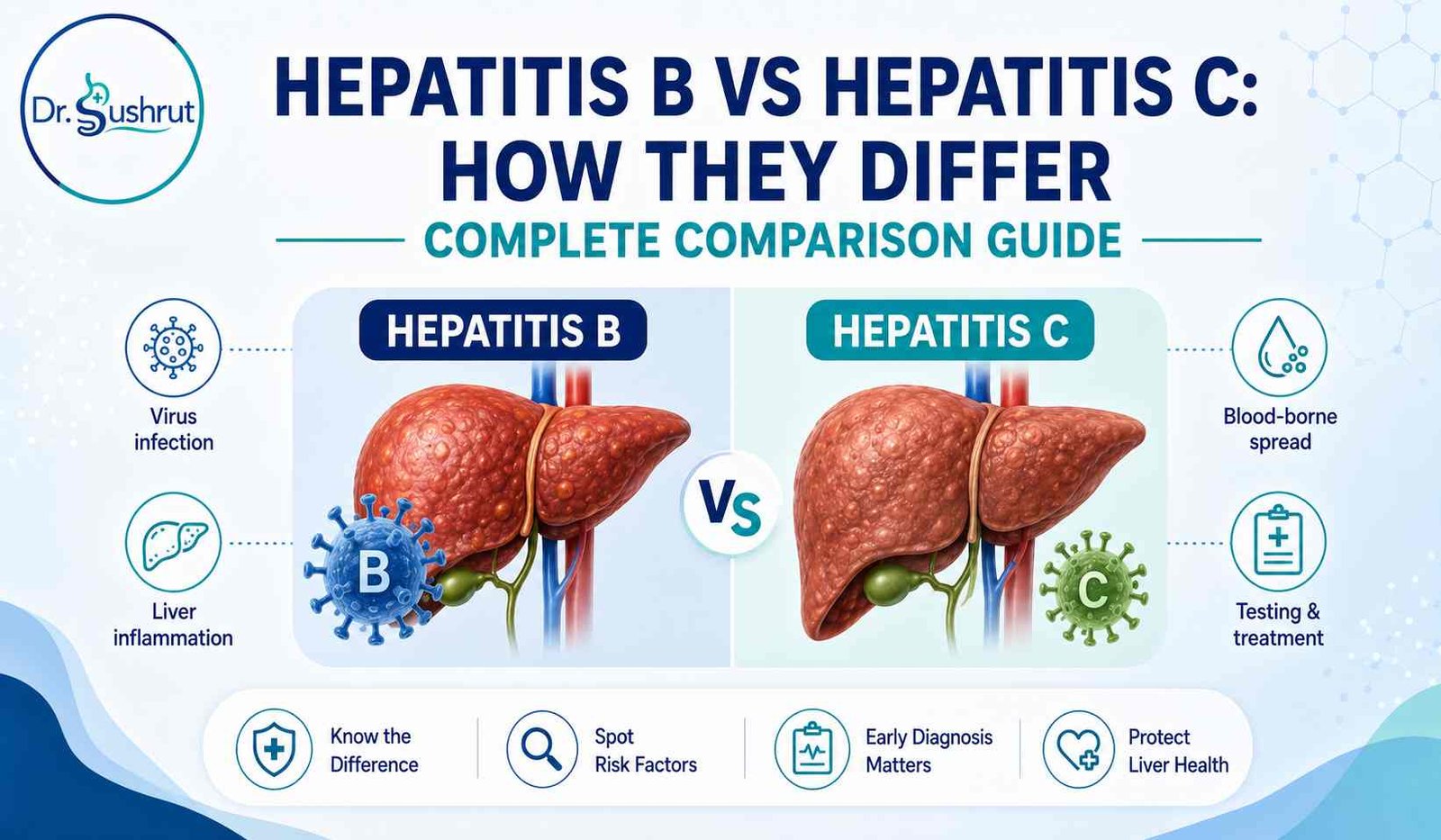
Both are called hepatitis. Both cause liver inflammation. Both are silent for years. Most patients hear the diagnosis and assume the two viruses are roughly the same disease. They are not. According to data published on PMC NCBI, roughly 29 million Indians live with chronic Hepatitis B and another 5.5 million with chronic Hepatitis C. The two infections have dramatically different transmission patterns, treatment approaches, and outcomes – and one of them is now reliably curable while the other is not.
This guide gives you a direct comparison of Hepatitis B and Hepatitis C on every parameter that matters – how each spreads, what symptoms to expect, how they are diagnosed, how they are treated, and what the long-term outlook looks like. Understanding which one you have (or are at risk of) changes everything about the care plan that follows.
Key Takeaways
- Hepatitis B has a vaccine; Hepatitis C does not.
- Hepatitis C is curable in 95-98% of cases with 12-week DAA therapy; Hepatitis B requires lifelong viral suppression.
- Hep B can cause liver cancer even without cirrhosis – a unique feature among hepatitis viruses.
- Both infections are largely silent – most patients have no symptoms until significant damage is done.
- India has around 29 million Hep B and 5.5 million Hep C patients – screening matters more than waiting for symptoms.
What Hepatitis B and C Actually Are
Hepatitis B (HBV) is a DNA virus from the Hepadnaviridae family, identified in 1965. It is one of the most successful pathogens at establishing chronic infection in humans.
Hepatitis C (HCV) is an RNA virus from the Flaviviridae family, identified much later in 1989. Both viruses target the liver, both cause chronic inflammation, and both can lead to cirrhosis and liver cancer over decades – but the similarities largely end there. They differ in how they spread, how the body responds to them, and crucially, how they are treated.
Hepatitis B vs Hepatitis C: Side-by-Side Comparison
Below is a parameter-by-parameter comparison of both infections on the clinical factors that matter for treatment decisions and prognosis:
| Parameter | Hepatitis B | Hepatitis C |
|---|---|---|
| Virus Type | DNA virus | RNA virus |
| India Prevalence | ~29 million people | ~5.5 million people |
| Main Transmission | Blood, sex, mother-to-child | Blood (transfusion, needles) |
| Adult Clearance Rate | 90-95% clear it | Only 15-25% clear |
| Chronic Infection Risk | 5-10% adults; 90% infants | 75-85% become chronic |
| Cancer Risk Without Cirrhosis | Yes – direct risk | Almost always needs cirrhosis first |
| Main Diagnostic Test | HBsAg + HBV DNA | Anti-HCV + HCV RNA |
| Treatment Approach | Lifelong viral suppression | 12-week curative therapy |
| Curable? | No (controllable) | Yes – 95-98% cure rate |
| Vaccine Available? | Yes – highly effective | No vaccine yet |
| Typical Treatment Cost | Rs 500 – Rs 3,000 / month | Rs 40,000 – Rs 90,000 one-time |
Whichever infection you have, knowing exactly how much liver damage has occurred is essential before any treatment decision. The FibroScan vs liver biopsy guide explains which test you need at this stage. For most Hep B and Hep C patients, FibroScan is the first-line tool – it tells your specialist exactly how much fibrosis or scarring has developed, which directly informs whether you need urgent antiviral therapy or routine monitoring. Liver biopsy is reserved for the small subset of cases where FibroScan is inconclusive or where coexisting conditions complicate the picture. Getting accurate staging matters – the same viral infection produces very different management plans at different stages of liver damage.
How They Spread: Transmission Differences
| Transmission Route | Hep B | Hep C |
|---|---|---|
| Blood transfusion (pre-screening era) | Yes | Yes – major route |
| Sharing needles or syringes | Yes | Yes – major route |
| Unsafe medical or dental procedures | Yes | Yes |
| Unsterilised tattoo or piercing | Yes | Yes |
| Sexual contact | Yes – common | Rare |
| Mother to child at birth | Yes – very common | Less common |
| Sharing razors or toothbrushes | Yes | Yes |
| Casual contact (hugging, sharing food) | No | No |
Symptoms: Why Both Are Called Silent Diseases
Chronic Hep B and Hep C are both silent for years – when symptoms appear, they are non-specific:
- Persistent fatigue that does not improve with rest
- Dull discomfort in the upper right abdomen
- Loss of appetite, mild nausea, joint aches
- Dark urine, pale stools, yellow eyes (advanced disease only)
These symptoms overlap heavily with other liver conditions. The Symptoms of Fatty Liver Disease guide covers NAFLD warning signs, which can coexist with chronic Hep B or Hep C in many Indian patients. Distinguishing viral hepatitis from fatty liver requires blood tests. Assuming your fatigue is fatty-liver-related when it is actually undiagnosed Hep C is how patients miss the window for curative DAA therapy. Symptoms alone do not separate the conditions.
Treatment: This is Where They Differ Most
Have You Ever Been Tested for Hepatitis?
Most chronic hepatitis carriers do not know they are infected. If any of these apply, get screened:
Blood transfusion before 2002 or unregulated tattoo or piercing
Family member with Hepatitis B or Hep B positive mother
Persistently elevated SGPT or SGOT on routine blood testsA single HBsAg + anti-HCV blood test costs under Rs 1,000.
The biggest difference between Hep B and Hep C is what treatment can achieve.
Hepatitis B treatment – Currently, no cure exists. Antivirals like Tenofovir and Entecavir suppress the virus and prevent disease progression, but the virus remains in the body. Most patients with active infection need lifelong therapy with quarterly monitoring. Treatment costs Rs 500 – Rs 3,000 per month for medication. The goal is to prevent cirrhosis and liver cancer, not to eliminate the virus from the body.
Hepatitis C treatment – Curable in 95-98% of patients with direct-acting antiviral (DAA) drugs. A 12-week course of Sofosbuvir + Velpatasvir or similar combinations eliminates the virus completely in most cases. Treatment costs Rs 40,000 – Rs 90,000 for the full course in India. After cure is confirmed by a follow-up RNA test, the virus is gone permanently, though monitoring continues for any pre-existing liver damage.
Whether you have Hep B (under suppression) or Hep C (post-cure), ongoing monitoring for any liver damage is part of long-term care. The early signs of liver damage guide covers the warning signals patients should watch for between specialist visits. Chronic hepatitis patients face a higher lifetime risk of cirrhosis and liver cancer even after viral control or cure – which means routine FibroScan and LFT monitoring should continue every 6-12 months indefinitely. Early detection of any progression allows for course correction before structural damage becomes irreversible. Patients who skip follow-up after starting treatment often discover late complications that could have been intercepted years earlier.
Your Hepatitis Treatment Path: What to Discuss With a Specialist
If you have tested positive for Hep B or Hep C, the next consultation should answer these specific questions. Walk in knowing what to ask:
Hepatitis B positive: What is my viral load (HBV DNA)? Am I in an active or carrier phase? Do I need antivirals now, or just monitoring?
Hepatitis C positive: What is my genotype? How much liver damage has occurred? When can I start DAA therapy and which combination is right for me?
Both cases: What liver assessment (FibroScan, LFT, ultrasound) do I need? How often should I follow up for cancer surveillance?
Dr. Sushrut Singh manages both Hepatitis B and C at his Gaur City clinic and Fortis Hospital, with on-site FibroScan and complete viral load and genotype workup capability.
Vaccination and Prevention
This is one area where Hep B and Hep C diverge sharply:
- Hepatitis B vaccine – Highly effective (over 95% protection). Three doses provide lifelong immunity in most people. Recommended for all newborns in India, healthcare workers, and high-risk adults. If you have not been vaccinated, ask your doctor.
- Hepatitis C vaccine – Not currently available. Despite decades of research, the genetic variability of the virus has prevented vaccine development. Prevention depends on safe blood, safe injection practices, and avoiding shared needles or unregulated medical procedures.
For Hep B, vaccination is the single most cost-effective preventive measure in medicine. For Hep C, vigilance about transmission routes is the only protection until a vaccine becomes available.
What’s Changing in Hepatitis Care
For Hep B, functional cure research is progressing rapidly – newer combinations targeting cccDNA may eventually achieve permanent viral elimination rather than just suppression. For Hep C, simpler 8-week DAA regimens are becoming available, and generic competition has continued to bring costs down in India. Universal Hep B vaccination at birth, now integrated into India’s national immunisation programme, will dramatically reduce new chronic infections over the next 20 years.
Conclusion
Hepatitis B and Hepatitis C share a name but differ in almost every clinically important way – transmission routes, infection course, treatment approach, and most importantly, curability. Hep B is controllable but not curable; Hep C is curable in nearly all cases. Both demand specialist management because both can progress silently to cirrhosis and liver cancer if neglected. The good news: screening for both is cheap and accessible, and modern treatment options have transformed the long-term outlook dramatically over the past decade.
Visit Dr. Sushrut Singh’s Clinic
Hepatitis management is a long-term partnership with a specialist who knows your case. Dr. Sushrut Singh consults at the Gaur City clinic and Fortis Hospital, with complete hepatitis workup and DAA therapy capability under one roof.
Get directions, see patient reviews, or call the clinic directly: Dr. Sushrut Singh’s Google Business Profile
Call or WhatsApp to book a hepatitis consultation.
Frequently Asked Questions (FAQs)
Can you have both Hepatitis B and C at the same time?
Yes – co-infection is possible and occurs in people exposed to both viruses, particularly those with multiple transfusion exposure or shared needle history. Co-infection accelerates liver damage and complicates treatment because both infections must be managed simultaneously. If you test positive for one, your specialist will routinely screen for the other.
If I am vaccinated for Hepatitis B, am I protected from Hepatitis C?
No. The Hep B vaccine provides no protection against Hep C – they are completely different viruses. There is no vaccine available for Hep C. Prevention for Hep C depends entirely on avoiding blood-borne exposure through safe medical practices, sterile equipment, and screened blood products.
How often should chronic Hep B or Hep C patients see a specialist?
Once stable on therapy or post-cure, every 6 months is typical. Active or recently diagnosed cases often need monitoring every 3 months initially, until viral load and liver enzymes stabilise. FibroScan, every 1-2 years, tracks fibrosis progression, and ultrasound surveillance for liver cancer is recommended for high-risk patients.