
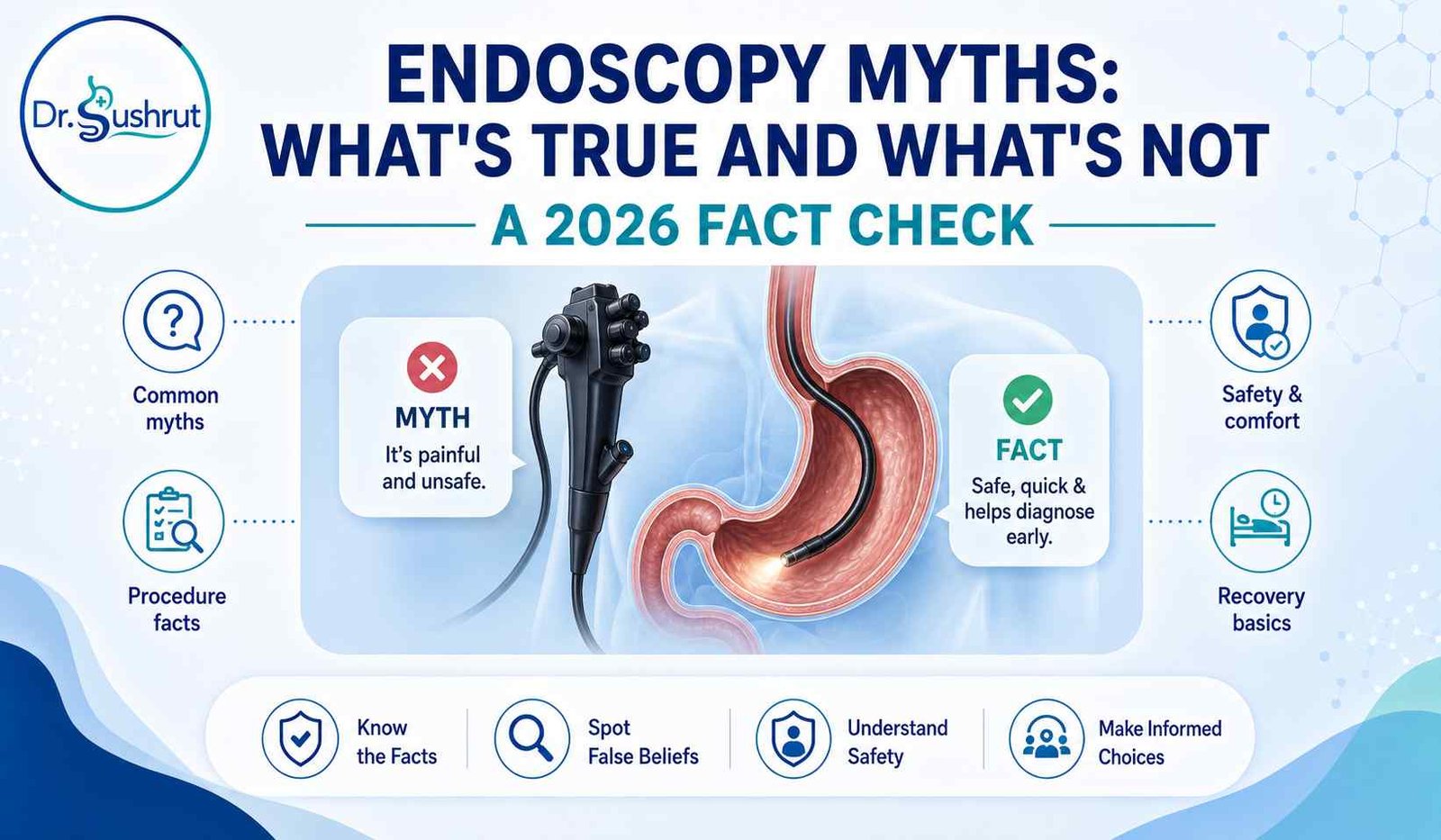
Very few procedures in gastroenterology carry as much unnecessary fear as an upper GI endoscopy. Patients arrive at consultations having already decided the scope will hurt, that they are too young for it, or that their antacid tablets are proof they do not need it. According to data published on PMC NCBI, diagnostic upper GI endoscopy is one of the most commonly performed and safest procedures in modern gastroenterology, yet misconceptions about its pain, safety, and necessity still delay timely diagnosis for lakhs of patients in India every year.
This guide separates the eight most common endoscopy myths from the medical reality. Some of these beliefs come from what patients hear from family members; some come from outdated internet articles; some come from a bad experience decades ago before conscious sedation became standard. Whatever the source, they influence real decisions – and often the wrong ones. Here is what the evidence and clinical experience actually say.
Key Takeaways
- Modern endoscopy is performed under conscious sedation – most patients sleep through the procedure and remember nothing.
- The procedure is day-care in almost all cases, with same-day discharge and return to normal activities within 24 hours.
- Age is not the deciding factor – symptoms and clinical indication are what determine who needs endoscopy.
- Complication rates are under 0.1% with experienced DM Gastroenterology specialists at accredited hospitals.
- Continuing antacids for months without endoscopy can hide serious conditions like ulcers, H. pylori, or early cancer.
Why These Myths Persist
Endoscopy has been performed in India for over three decades, and much of the fear patients carry today comes from what the procedure looked like in the 1990s – before conscious sedation became standard, before flexible high-definition scopes replaced older instruments, and before day-care protocols were established. Add to this the fact that patients often hear about complications from friends and family who had procedures done at low-volume centres by inexperienced operators, and the composite picture that reaches the average patient is misleading. The medical reality has moved on; patient perception has not.
The Most Common Endoscopy Myths vs Medical Reality
Below is a side-by-side comparison of the eight most common patient beliefs against what current gastroenterology practice actually shows. Recognising which of these you carried in with you is the first step to making a rational decision about whether the procedure is right for your case:
| Common Myth | Medical Reality |
|---|---|
| Endoscopy is extremely painful | Done under conscious sedation – most patients sleep through it |
| You will stay in hospital for days | Day-care procedure – discharge on the same day |
| Only elderly patients need endoscopy | Age is not the trigger – symptoms and clinical indication are |
| The scope will make you choke or vomit | Sedation blocks the gag reflex; choking is prevented |
| Endoscopy is dangerous with high risks | Complication rate is under 0.1% with experienced operators |
| Endoscopy causes cancer or long-term damage | There is no causal link; endoscopy detects disease, does not cause it |
| If antacids work, endoscopy is unnecessary | Antacids mask symptoms – some conditions still need direct visualisation |
| Every stomach ache needs an endoscopy | Only specific symptom patterns warrant it |
Reading this list is one thing; deciding what actually applies to your specific case is another. Talking to an Expert Gastroenterologist in Greater Noida who performs endoscopy routinely will give you a clearer answer than a comparison table can. A DM Gastroenterology specialist has seen enough cases to know when a patient’s fear is protecting them from an unnecessary procedure and when the same fear is delaying a diagnosis that will only get harder to treat over time. Do not confuse the two – the first is prudence, the second is procrastination dressed up as caution.
Myth #1: ‘Endoscopy is Extremely Painful’
This is by far the most common concern, and it is the easiest to correct with facts. Modern upper GI endoscopy is performed under conscious sedation – the patient receives a short-acting sedative through an IV line just before the procedure begins. Within a minute or two, the patient is asleep or in a very light state of awareness where they do not respond to touch or verbal commands. The scope is then passed through the mouth and into the stomach without the patient feeling the process. Most patients wake up in the recovery area 20-30 minutes later with no memory of the procedure at all.
The residual sensation, if any, is mild throat irritation for a few hours afterward – similar to what you might feel after a bad cold. That is it. The idea that endoscopy involves being wide awake while a scope is forced down an unwilling throat comes from a version of the procedure that has not been standard practice in India for over twenty years.
If you want a fuller understanding of what the procedure actually involves – the equipment used, the sedation protocol, the safety measures, and the specific conditions endoscopy diagnoses – the dedicated Endoscopy in Greater Noida page covers each step in detail. What matters for this section is the shift in patient reaction that happens once the sedation myth is cleared: most patients who arrive apprehensive walk out of the recovery area surprised at how uneventful the experience was. The anxiety was the hardest part, not the procedure.
Myth #2: ‘Only Older Patients Need Endoscopy’
This one is dangerously wrong. Endoscopy is a symptom-driven investigation, not an age-driven one. A 25-year-old with persistent unexplained upper abdominal pain, unexplained iron deficiency anaemia, difficulty swallowing, or black tarry stools needs endoscopy just as urgently as a 65-year-old with the same symptoms – sometimes more urgently, because young patients are often dismissed by their families and end up presenting later with more advanced disease.
The reverse is also true: an 80-year-old with no upper GI symptoms and no risk factors does not need routine endoscopy just because of age. The correct trigger is a specific clinical pattern – not birthdays. If a family member is refusing endoscopy on the grounds of being too young, or being pushed into one on the grounds of being older, the age argument should be replaced with a symptom-by-symptom discussion with a specialist. What matters is the presence of specific red-flag features – not the number on the calendar – and a good specialist walks the patient through this framing before booking anything.
Cost is the other frequent objection – and often it is quieter than the pain fear because patients are embarrassed to raise it. The published Endoscopy Cost in Greater Noida guide breaks down what a diagnostic endoscopy actually costs versus what a therapeutic one costs, what insurance typically covers under day-care benefits, and what add-ons like biopsy fees or anaesthesia charges look like when itemised. Bring that number into the conversation openly. A specialist who knows your financial constraint upfront can often suggest a phased approach or defer non-essential add-ons; a specialist kept in the dark cannot.
Myth #3: ‘Endoscopy is Dangerous’
This belief usually comes from hearing about a complication that happened to someone – a perforation, bleeding, an infection. These complications do exist, but the numbers matter more than the stories. The complication rate for diagnostic upper GI endoscopy is strongly linked to how many procedures the operator has done in their career, as shown below:
| Operator Experience | Reported Complication Rate |
|---|---|
| Under 100 procedures done | 0.5% – 1.2% |
| 100-500 procedures done | 0.2% – 0.5% |
| 500+ procedures done | Under 0.1% |
| DM Gastroenterology specialist, 1,000+ procedures | 0.05% and below |
The takeaway is not that endoscopy is risk-free – no procedure is. It is that the risk is largely a function of operator experience and centre volume, and it is well below the risk of leaving many upper GI conditions undiagnosed. A DM Gastroenterology specialist with 1,000+ procedures at a NABH-accredited hospital gives a very different risk profile from a general physician using an endoscope occasionally at a small clinic. Choose the operator and centre, not the procedure – the procedure itself is not the variable.
When You Actually Need Endoscopy vs When You Do Not
The clearest way to cut through the myths is to look at specific clinical scenarios. Endoscopy is genuinely indicated when the following are present:
- Persistent acid reflux or heartburn that has not responded to 4-6 weeks of proper medication
- Difficulty or pain when swallowing food or liquids
- Black tarry stools or vomiting of blood or coffee-ground material
- Unexplained iron deficiency anaemia workup
- Unexplained weight loss with upper GI symptoms
- Surveillance in Barrett’s esophagus, prior ulcer, or family history of gastric cancer
Endoscopy is generally not needed for occasional heartburn responsive to antacids, isolated single episodes of vomiting, functional dyspepsia responding to lifestyle changes, or the vague upper abdominal discomfort of the type most adults experience from time to time. A good specialist tells you which category your symptoms fall into – and equally importantly, tells you when you do not need the procedure.
Not Sure Whether You Actually Need an Endoscopy?
The line between symptoms that warrant a scope and symptoms that do not is a clinical judgement, not a rule of thumb. Talk to a DM Gastroenterology specialist before the internet or your neighbour talks you out of a procedure you may genuinely need – or into one you do not.
Call Dr. Sushrut: +91 93153 54431
Future Trends: What’s Changing in 2026
Sedation protocols are shifting toward shorter-acting agents that cut recovery time from 30 minutes to under 15. Ultra-thin transnasal endoscopes are becoming available for selected diagnostic cases, which some centres offer without sedation for patients who prefer to stay fully awake. AI-assisted lesion detection is improving the diagnostic yield during endoscopy, reducing missed lesions in surveillance cases. For patients, the practical outcome of these changes is faster, safer, and less anxiety-provoking procedures each year.
Conclusion
Most endoscopy myths are inherited from an earlier era of the procedure and rarely reflect current practice at experienced centres. The correct decision about whether you need one is not based on age, on how much you have heard about it hurting, or on how well your antacids seem to be working – it is based on the specific symptom pattern you have and what a trained specialist can see when they look. Separate the fears from the facts, then have the conversation.
How Many of These Did You Believe Before Reading This?
Tick each statement that sounded true to you before today. There are no right or wrong answers – most patients arrive at their first consultation carrying at least two or three of these beliefs:
- Endoscopy is going to hurt a lot
- The scope might damage something inside
- I am too young for this kind of procedure
- If my medicine is working, I do not need a scope
- Once endoscopy is done, my problem will get worse
- I will need days off work to recover
If you ticked 3 or more: Your hesitation is based on outdated information. A 10-minute specialist conversation clears most of it up – and tells you whether you even need the procedure in the first place.
Frequently Asked Questions (FAQs)
Will I be awake during the endoscopy?
No, almost certainly not. Standard practice is conscious sedation through an IV line, and most patients sleep through the entire procedure with no memory of it afterward. A very small number of patients specifically request or medically require unsedated endoscopy, but this is the exception, not the rule. If you are worried about being awake, this is one of the first things to confirm with the endoscopy centre before you book.
How soon can I return to normal activity after endoscopy?
Same day for most activities, next day for anything demanding. The sedation wears off within a few hours, though you should not drive or make important decisions on the day of the procedure. Most patients return to office work the next morning. Physically strenuous work or exercise is fine within 24 hours unless a biopsy or intervention was done that changes the recovery timeline.
Can endoscopy detect cancer at an early stage?
Yes, and this is one of its most important uses. Early gastric and esophageal cancers often show no symptoms and are found only when endoscopy is done for other reasons. This is why patients with risk factors like family history, Barrett’s esophagus, or prior gastric ulcer are advised regular surveillance endoscopy – early detection changes outcomes significantly compared to late presentation.
Is endoscopy covered under health insurance?
Almost always, when medically indicated by a specialist. Endoscopy is covered under day-care benefits by most Indian health insurance policies, which means you do not need overnight admission for the claim to go through. Confirm inclusions with your TPA before booking, ask for pre-authorisation, and request an itemised written estimate so surprise add-ons do not derail the reimbursement.
Book Your Consultation at Either Location
Both clinics offer the same specialist evaluation and procedural expertise. Choose the location most convenient for you:
Gaur City Clinic – Greater Noida West
Fortis Hospital – Sector 62
Same specialist. Same standards. Your choice of location.