
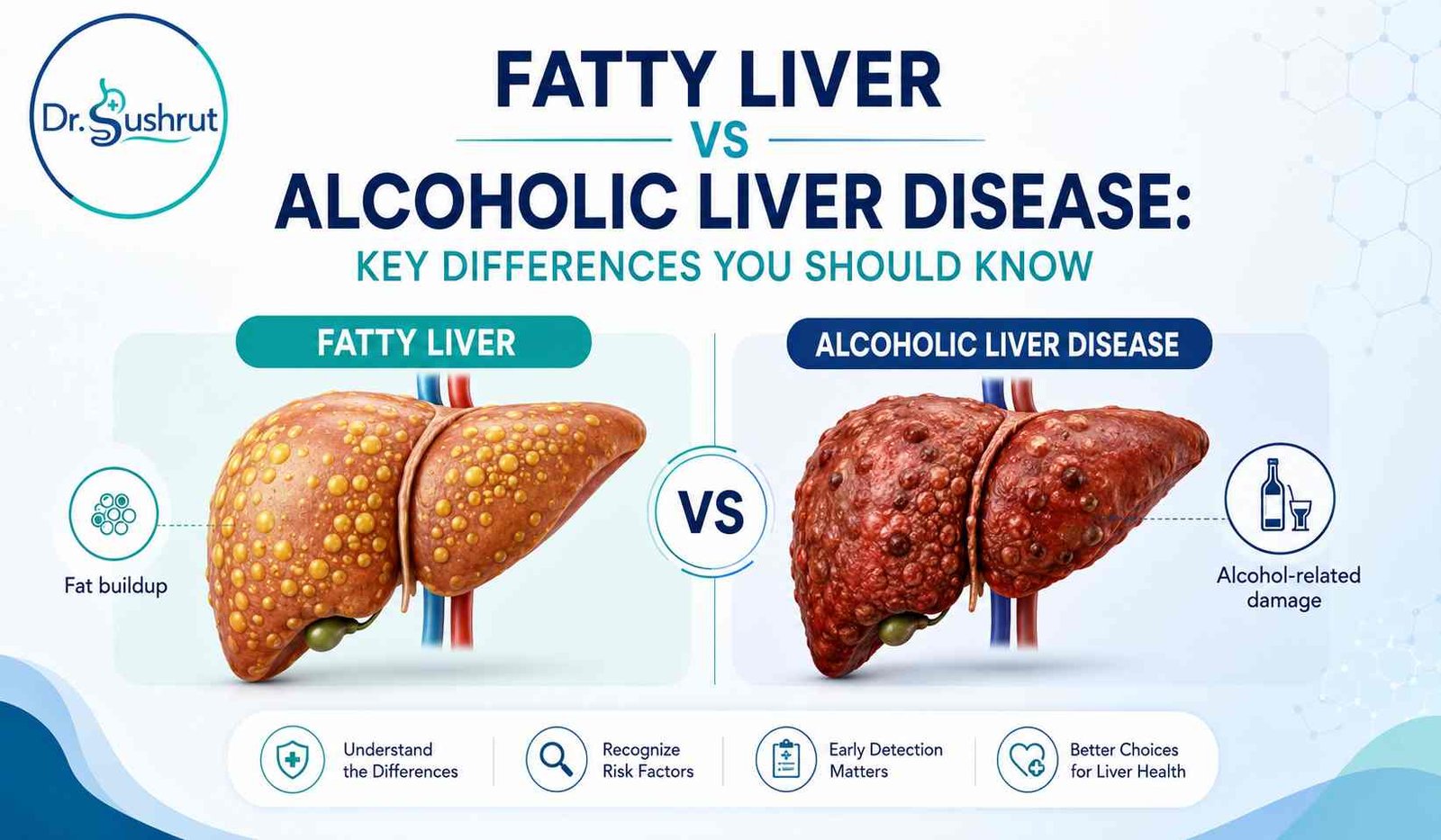
Both conditions cause fat to build up in the liver. Both show up similarly on ultrasound. Both can progress to cirrhosis if neglected. Most patients hearing either diagnosis assume they are roughly the same disease. They are not. According to data published on PMC NCBI, non-alcoholic fatty liver disease now affects roughly 30% of urban Indian adults, while alcoholic liver disease affects another 3-5% – and the two are increasingly overlapping in patients with both metabolic risk and significant alcohol intake. The treatment path for each is drastically different.
This guide gives you a direct comparison of non-alcoholic fatty liver disease (NAFLD, now reclassified as MASLD) and alcoholic liver disease (ALD). You will see exactly how each one develops, how each one progresses, why the symptoms look so similar, and most importantly, why the management of each is fundamentally different. Honest self-assessment is the first step toward the right diagnosis.
Key Takeaways
- NAFLD is caused by metabolic dysfunction (obesity, diabetes, dyslipidemia); ALD is caused directly by alcohol consumption.
- Both can progress through fatty liver, inflammation, fibrosis, and cirrhosis – but ALD can also cause acute alcoholic hepatitis with high short-term mortality.
- NAFLD reverses with weight loss and metabolic control; ALD reverses only with complete alcohol abstinence.
- Both conditions can coexist in the same patient (MetALD) – and the combination progresses faster than either alone.
- Diagnosis requires honest drinking history plus blood tests – lab patterns differ between NAFLD and ALD even when imaging looks similar.
What Each Condition Actually Is
Non-Alcoholic Fatty Liver Disease (NAFLD), now formally renamed MASLD (Metabolically Associated Fatty Liver Disease), is fat accumulation in liver cells driven by metabolic factors – insulin resistance, obesity, type 2 diabetes, and dyslipidemia. Alcoholic Liver Disease (ALD) is the accumulation of fat and direct toxic damage caused by chronic alcohol consumption.
Despite identical-looking fatty infiltration on ultrasound, the two conditions have completely different cellular drivers, progression patterns, and treatment requirements. A patient with significant alcohol intake AND metabolic risk has a combined condition called MetALD, which progresses faster than either pathway alone.
Fatty Liver vs Alcoholic Liver Disease: Side-by-Side Comparison
Below is a parameter-by-parameter comparison of both conditions on the clinical factors that actually drive treatment decisions:
| Parameter | Fatty Liver (NAFLD) | Alcoholic Liver Disease |
|---|---|---|
| Primary Cause | Metabolic dysfunction | Chronic alcohol consumption |
| Alcohol Role | Minimal or none | Direct cause |
| India Prevalence | ~30% of urban adults | ~3-5% of adults |
| Typical Patient | Overweight, diabetic, sedentary | Variable weight; heavy drinking history |
| Acute Risk | Low (silent progression) | Alcoholic hepatitis can be fatal |
| Main Lab Pattern | Mildly elevated ALT | Elevated GGT; AST higher than ALT |
| Reversibility (Early) | Yes – lifestyle change | Yes – complete abstinence |
| Progression Speed | Slow (decades) | Faster if drinking continues |
| Cirrhosis Risk | 10-20% lifetime | 15-30% if drinking persists |
| Liver Cancer Risk | Rises at cirrhosis stage | Rises at cirrhosis stage |
| Treatment Cornerstone | Weight loss + metabolic control | Complete alcohol cessation |
| Drug Therapy | Limited (Resmetirom for select cases) | Steroids for severe alcoholic hepatitis |
Fatty liver and alcoholic liver are far from the only causes of liver disease your specialist will rule out. Viral hepatitis is another major category – chronic Hepatitis B and C produce similar liver inflammation patterns but require completely different management. The Hepatitis B vs Hepatitis C guide covers how viral hepatitis differs from both NAFLD and ALD in cause, transmission, and treatment. Anyone presenting with elevated liver enzymes or fatty liver on ultrasound should be screened for Hep B and Hep C as part of the standard workup – viral hepatitis can silently coexist with fatty liver and accelerate damage substantially. Distinguishing between viral, metabolic, and alcohol-driven liver disease is the first task of any thorough liver evaluation.
What Causes Each Condition
NAFLD/MASLD – Driven by metabolic syndrome. Risk factors include obesity (especially abdominal fat), type 2 diabetes, insulin resistance, high cholesterol, hypertension, and sedentary lifestyle. Genetic factors play a role, but lifestyle is the primary modifiable driver.
ALD – Driven by chronic, sustained alcohol consumption above safe limits. The threshold varies by individual and gender, but regular intake of more than 21 units per week for men or 14 units for women dramatically increases risk. Binge drinking adds acute injury risk on top of chronic damage.
Symptoms: Why Both Are Silent Until Late
Both conditions produce minimal symptoms until significant damage has occurred. Common late symptoms include:
- Persistent fatigue and weakness
- Dull discomfort in the upper right abdomen
- Mild nausea, reduced appetite
- Yellowing of skin or eyes (advanced disease)
ALD has one additional acute presentation that NAFLD does not – alcoholic hepatitis. This can manifest with sudden jaundice, severe abdominal pain, fever, and confusion. Acute alcoholic hepatitis carries a 30-50% short-term mortality risk in severe cases and is a medical emergency.
Whichever pathway your specialist suspects, accurate staging is essential before treatment planning. The Liver biopsy vs FibroScan guide explains which test answers the question for your case. For most NAFLD patients, FibroScan is sufficient – it measures both liver stiffness and fat content non-invasively. For ALD patients, FibroScan is often combined with blood tests like AST/ALT ratio and GGT for a complete picture. Biopsy is reserved for cases where the diagnosis is genuinely unclear or where multiple conditions are suspected to coexist. The same imaging finding (fatty liver on ultrasound) can mean different things in different patients – which is why structured staging matters more than the initial scan.
Treatment: This is Where They Differ Most
NAFLD treatment – The cornerstone is metabolic correction. Goals: 7-10% body weight loss, diabetes control, normalisation of lipids and blood pressure, and increased physical activity. For severe NASH with fibrosis, Resmetirom (recently approved internationally) is the first dedicated drug therapy. Most patients respond well to lifestyle change if started early. Monitoring usually involves FibroScan every 6-12 months and quarterly liver enzyme panels.
ALD treatment – The cornerstone is complete alcohol abstinence. No medication or lifestyle change can substitute for stopping alcohol entirely. Nutritional support is critical because most ALD patients are malnourished. Severe alcoholic hepatitis may require corticosteroids in hospital. Long-term, addiction support is essential – relapse rates are high without structured rehabilitation and family involvement during recovery.
Choosing the right specialist matters more in liver disease than in many other fields because the management plan depends entirely on accurate categorisation of which type of liver disease you have. A Gastroenterologist Expert in Greater Noida with DM Gastroenterology qualification can run the full workup – viral screen, metabolic panel, alcohol assessment, FibroScan staging – in a single consultation cycle, which prevents the months of fragmented testing that often happens when liver disease is investigated piecemeal across multiple physicians. Coordinated workup also matters because NAFLD, ALD, viral hepatitis, and autoimmune liver disease can coexist in the same patient – missing the secondary diagnosis is one of the most common reasons treatment fails. Comprehensive evaluation by one specialist saves time, money, and progression risk.
How Each Condition Progresses
Both conditions progress through similar histological stages but with different speeds and acute risks:
| Stage | Fatty Liver (NAFLD) | Alcoholic Liver Disease |
|---|---|---|
| Stage 1 | Simple steatosis (fat accumulation) | Alcoholic fatty liver |
| Stage 2 | NASH (steatohepatitis with inflammation) | Alcoholic hepatitis (can be acute, severe) |
| Stage 3 | Fibrosis (scar tissue forming) | Alcoholic fibrosis |
| Stage 4 | Cirrhosis (irreversible scarring) | Alcoholic cirrhosis |
Note that ALD’s Stage 2 (alcoholic hepatitis) can be a sudden, severe, life-threatening event – while NAFLD’s Stage 2 (NASH) is typically a slow, silent process that takes years to manifest. This single distinction explains why ALD often requires more urgent intervention even when both conditions appear similar on initial ultrasound.
What’s Changing in 2026
MASLD nomenclature is replacing NAFLD globally – the rebranding emphasises metabolic root causes and reduces the stigma of “non-alcoholic” labelling. Resmetirom is the first specific drug approved for advanced NAFLD/NASH, with several more GLP-1 and FGF21 analogues in late-stage trials. For ALD, structured rehabilitation programmes integrated with medical management are showing significantly improved outcomes compared to medical treatment alone. Combined MetALD is increasingly recognised as a distinct, faster-progressing entity requiring dual-track intervention.
Conclusion
Fatty liver and alcoholic liver disease share a similar appearance on ultrasound but differ fundamentally in cause, progression risk, and treatment. NAFLD demands metabolic correction; ALD demands abstinence. Both can be reversed at early stages and both can progress silently to cirrhosis if ignored. The single most important step is honest categorisation – which type of liver disease do you actually have? Get that answer right, and the rest of the treatment plan follows logically.
Which One Do You Have? Honest Self-Check Guide
Use this honest assessment before your specialist visit. The answer changes which test, treatment, and follow-up plan you actually need:
Question 1: How many alcoholic drinks per week, honestly?
0 to 2 drinks per week: Almost certainly NAFLD pathway. Focus on metabolic workup.
3 to 14 drinks per week: Mixed picture (MetALD). Both pathways may be active.
14+ drinks per week regularly: ALD pathway. Abstinence is non-negotiable.Question 2: Do any of these apply – BMI above 25, diabetes, high cholesterol, hypertension?
If yes to one or more AND your drinking is minimal, NAFLD is the likely diagnosis. If yes AND drinking is significant, MetALD is likely – which carries higher progression risk than either condition alone.
Walk into your specialist visit with this honest assessment. The right treatment plan depends entirely on the right diagnosis.
Frequently Asked Questions (FAQs)
Can someone have both fatty liver and alcoholic liver disease at the same time?
Yes – this combined condition is called MetALD (Metabolic Alcohol-associated Liver Disease) and is increasingly recognised in patients with both obesity or diabetes AND significant alcohol intake. MetALD progresses faster than either NAFLD or ALD alone and requires dual-track management – both metabolic correction and alcohol cessation.
How much alcohol is actually safe for the liver?
From a strict liver-protection standpoint, there is no proven safe alcohol threshold. Most clinical guidelines suggest staying below 14 units per week for women and 21 units per week for men to minimise risk, but lower is better. Patients with existing fatty liver or metabolic syndrome are advised to abstain completely until reassessment.
If I stop drinking, will alcoholic liver disease reverse?
At the fatty liver stage, yes – complete abstinence usually reverses alcoholic fatty liver within weeks to months. At the alcoholic hepatitis or fibrosis stage, abstinence stops progression and allows partial recovery. At the cirrhosis stage, abstinence prevents further damage but the scarring is permanent. The earlier you stop, the more reversible the damage.