
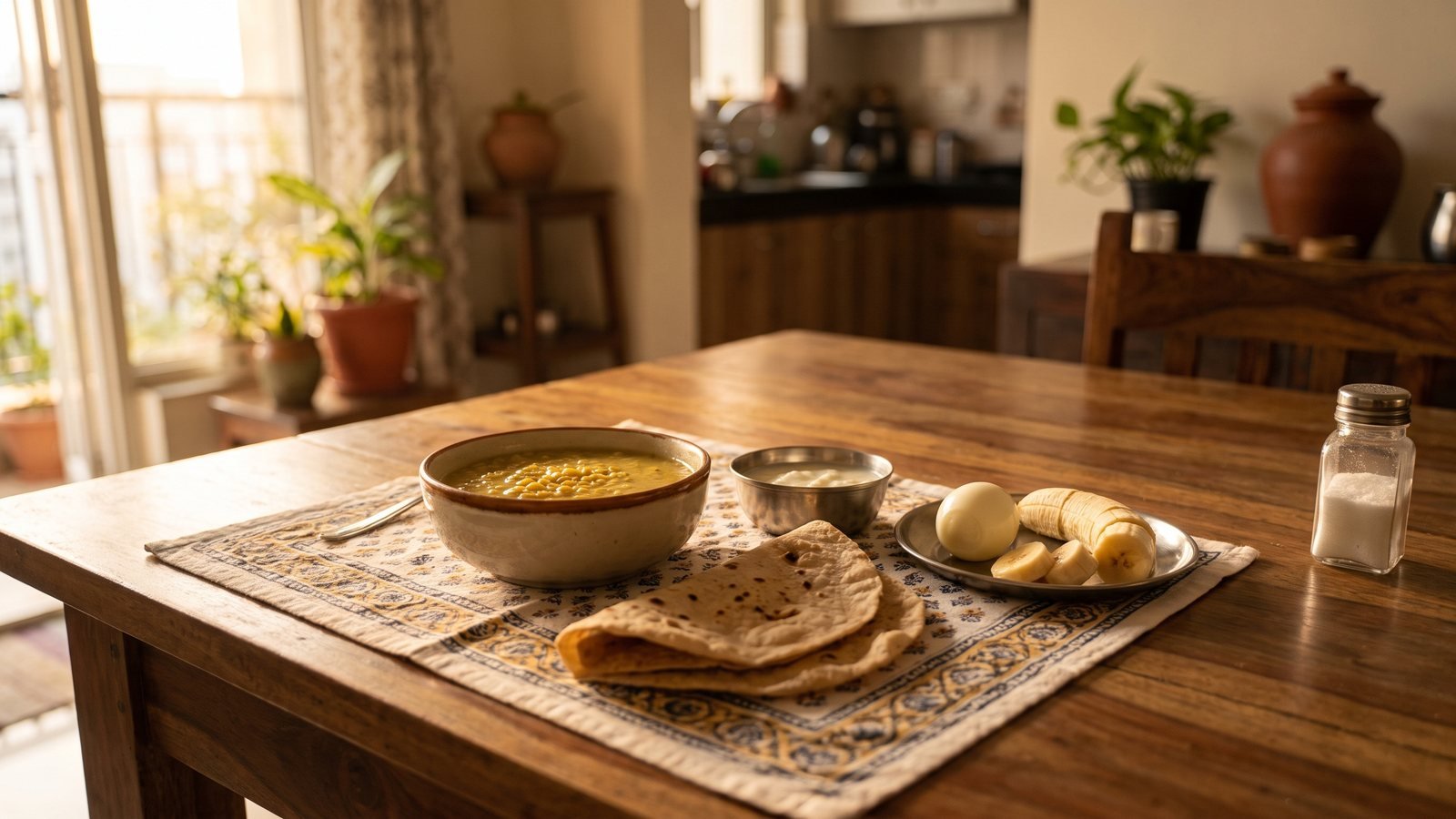
The discharge summary says “cirrhosis with ascites”, and by evening the family has three rules from three relatives: no protein, no salt, only khichdi. Each sounds careful, and each can do harm if followed to the letter. The Indian National Association for Study of the Liver (INASL) notes that Indian studies find malnutrition and muscle loss in 47% to 84% of people with cirrhosis, higher than the global figure, and a plate stripped of protein only adds to that loss.
This page is for the person with cirrhosis and the family member who cooks: how much protein the day needs, why a bedtime snack matters, what a salt limit looks like at home, a 7-day chart, and the signs that need a hospital.
Key Takeaways
- Most people with cirrhosis need more protein than a healthy adult, about 1.2 to 1.5 g per kg of body weight a day.
- Eat every few hours, with a late-evening snack so the night-time fast stays short.
- With ascites, salt is held to about 5 g a day in total, roughly one teaspoon. Limited, not zero.
- Water is restricted only when the doctor finds low blood sodium.
- No alcohol, raw shellfish, unboiled milk or herbal “liver tonics”.
What a Cirrhosis Diet Is Meant to Do
Definition: Cirrhosis is advanced scarring of the liver after years of injury from alcohol, fatty liver, hepatitis B or C, or other causes. “Decompensated” means complications have appeared, such as ascites (fluid in the belly), hepatic encephalopathy (confusion from toxins the liver cannot clear) or bleeding from swollen veins in the food pipe.
A scarred liver holds very little stored energy. Without regular food, the body slips into a starvation-like state far sooner than a healthy person’s would and breaks down muscle for fuel. INASL links this muscle loss with more ascites, more confusion episodes and more infections.
So the diet has three jobs: enough protein and energy to protect muscle, short gaps between meals, and less salt when there is fluid. How the disease is staged and treated is explained in cirrhosis symptoms, stages and treatment; this page is the kitchen side of it.
More Protein, Not Less
Protein was once cut in cirrhosis out of fear that it would bring on confusion. Later studies did not bear this out. The EASL guideline on nutrition in chronic liver disease states that normal to high protein intake does not trigger hepatic encephalopathy, and tells patients plainly not to reduce total protein. Its daily targets:
- Protein: at least 1.2 to 1.5 g per kg of body weight, against about 0.83 g per kg for a healthy adult (ICMR-NIN).
- Energy: at least 35 kcal per kg for someone who is not overweight.
For a 60 kg person, that is about 72 to 90 g of protein and around 2,100 kcal a day. With ascites, the doctor works from an estimated dry weight, the weight without the fluid. If the person is overweight, as often happens when cirrhosis grew out of fatty liver, calories may be trimmed under supervision while protein stays high.
| Vegetarian protein | Non-vegetarian protein |
|---|---|
| Dal, rajma, chana, sprouts | Eggs, boiled or as bhurji |
| Paneer, curd, chaas, milk | Fish curry or steamed fish |
| Soya chunks, besan or moong chilla | Home-cooked chicken curry or tikka |
Put at least one of these in every meal and snack. Some people with hepatic encephalopathy cope better with dal, milk and curd than with meat, and INASL advises leaning on vegetable and dairy protein rather than cutting protein. When food alone falls short, the doctor may add a nutrition supplement, one of the running costs in what cirrhosis care usually costs.
Small Meals and a Bedtime Snack
EASL advises three main meals and three snacks: mid-morning, mid-afternoon and late evening. It calls the late-evening snack the most important, as it covers the long gap between dinner and breakfast. INASL recommends small, frequent meals, a protein-rich breakfast and a bedtime snack of complex carbohydrate such as dalia, poha or roti. Keep the bedtime snack even after a late dinner, and ask the doctor before any all-day vrat.
Salt for Ascites: Limited, Not Zero
With ascites or swollen feet, the body holds on to sodium, and salt brings water with it. EASL and INASL suggest a moderate limit of 2 g of sodium a day, about 5 g of salt. The ICMR-NIN Dietary Guidelines for Indians put 5 g of salt at about one teaspoon. That is the whole day’s salt, including salt already in food.
- Namak in cooking: measure the day’s salt into a small bowl each morning and cook from it.
- Papad, achaar and namkeen: ICMR-NIN lists them among high-salt home foods.
- Packaged foods: chips, biscuits, bakery items, instant noodles, sauces, ketchup.
- Baking soda in dhokla and some batters adds sodium; sendha namak and kala namak are still salt.
Lemon, jeera, hing and pudina add flavour. Going stricter is not safer: INASL links cutting salt below 5 g a day with low blood sodium and kidney strain, and bland food makes people eat less. Water is restricted only when a blood test shows low sodium and the doctor sets a daily limit.
Foods to Avoid
Alcohol stops completely; EASL notes that virtually no food other than alcohol damages the liver. If others at home drink regularly or have fatty liver, the early signs of liver damage are worth knowing.
- Raw or undercooked shellfish, oysters and sushi. A CDC report from Florida found that adults with liver disease who ate raw oysters developed Vibrio vulnificus infection about 80 times as often as raw-oyster eaters without known liver disease.
- Unboiled loose milk and raw-milk paneer. Cirrhosis lowers defences against infection, so boil milk or use pasteurised milk.
- Herbal “liver tonics”, churans and detox powders. INASL reports liver injury from such products.
Myths and facts
- “Protein harms the liver.” INASL calls low-protein advice a myth; cutting protein wastes muscle.
- “No ghee or oil at all.” Fat is a needed energy source in cirrhosis; normal amounts are fine.
- “Only khichdi.” Khichdi alone rarely reaches the protein target; add extra dal, curd, paneer or egg.
7-Day Liver Cirrhosis Diet Chart (Indian)
Add a mid-morning fruit, chaas or roasted chana daily. Cook with little salt and normal oil; portions follow appetite and the dietitian’s target. Vegetarians take the first option.
| Day | Breakfast | Lunch | Evening | Dinner | Bedtime snack |
|---|---|---|---|---|---|
| Mon | 2 besan chilla, curd | 2 phulka, moong dal, lauki, curd | Roasted chana, fruit | 2 phulka, palak paneer or egg curry | Milk, small bowl of dalia |
| Tue | Poha with peanuts, milk | Rice, rajma, sabzi, chaas | Boiled sprouts with lemon | 2 phulka, mixed dal or fish curry | Small katori curd rice |
| Wed | Paneer bhurji or 2-egg omelette, 1 phulka | Rice, sambar, beans, curd | Roasted makhana, milk | Moong dal khichdi, curd, or chicken stew | Milk, small bowl of poha |
| Thu | 3 idli, sambar | 2 phulka, chana dal, tori, curd | Fruit, peanuts | 2 phulka, soya sabzi or fish curry | Banana, glass of milk |
| Fri | Vegetable upma, milk or egg | Rice, kadhi, bhindi | Moong chilla, chaas | 2 phulka, matar paneer or chicken curry | Milk, small bowl of dalia |
| Sat | Moong dal chilla, curd | 2 missi roti, lauki chana dal, raita | Milk, roasted chana | Vegetable or egg pulao, raita | Small katori curd rice |
| Sun | Paneer or dal paratha, curd | Rice, toor dal, sabzi, fish or paneer | Fruit, chaas | Dal khichdi, sabzi, curd | Milk, small bowl of sevai kheer |
With diabetes, the doctor or dietitian adjusts the rice, fruit and sugar.
When Diet Changes Are Urgent
Go to hospital the same day if any of these appear
- Confusion, unusual drowsiness or a change in behaviour
- Vomiting blood, or black, tarry stools
- Belly or legs swelling fast, or breathlessness
- Fever with belly pain, very little urine, or no food kept down for a day
These need treatment, not a new food rule. Families often stop all protein when confusion starts; do not, unless the treating team asks. After any admission, recheck the salt, fluid and protein advice.
What’s Changing in Cirrhosis Nutrition
Muscle is increasingly measured rather than guessed. INASL describes hand-grip strength and muscle area on a CT scan as ways to spot muscle loss early. Research is still working out what the ideal bedtime snack contains.
Conclusion
A liver cirrhosis diet chart in Indian food is not khichdi without salt. It is protein at every meal, food every few hours with a bedtime snack, about a teaspoon of salt a day when there is fluid, and no alcohol. Diet supports medical treatment; it does not replace it.
A diet plan for a liver with cirrhosis Protein, salt and fluid targets depend on the stage, blood sodium, kidney function and any diabetes. Dr Sushrut Singh, a gastroenterologist with a DM from ILBS, New Delhi, consults at Fortis Hospital, Sector 62, Noida, and at his clinic in Gaur City 2, Greater Noida West. Call or WhatsApp 093153 54431 and bring the latest blood reports, ultrasound and medicine list.
Frequently Asked Questions (FAQs)
Can a liver cirrhosis patient eat eggs?
Usually yes. Eggs are an easy, affordable protein. If confusion episodes occur, the doctor may suggest leaning more on dal, milk and curd.
How much water should a cirrhosis patient drink?
Normal amounts, unless the doctor finds low blood sodium and sets a limit. Do not restrict water on your own, especially while on water tablets.
Is rice or khichdi good for cirrhosis?
Both are fine. Khichdi with extra moong dal, a katori of curd and a sabzi makes a complete meal.
Can I use ghee or oil with cirrhosis?
Yes, in normal amounts. Fat supplies energy, and cutting it out makes it harder to eat enough.