
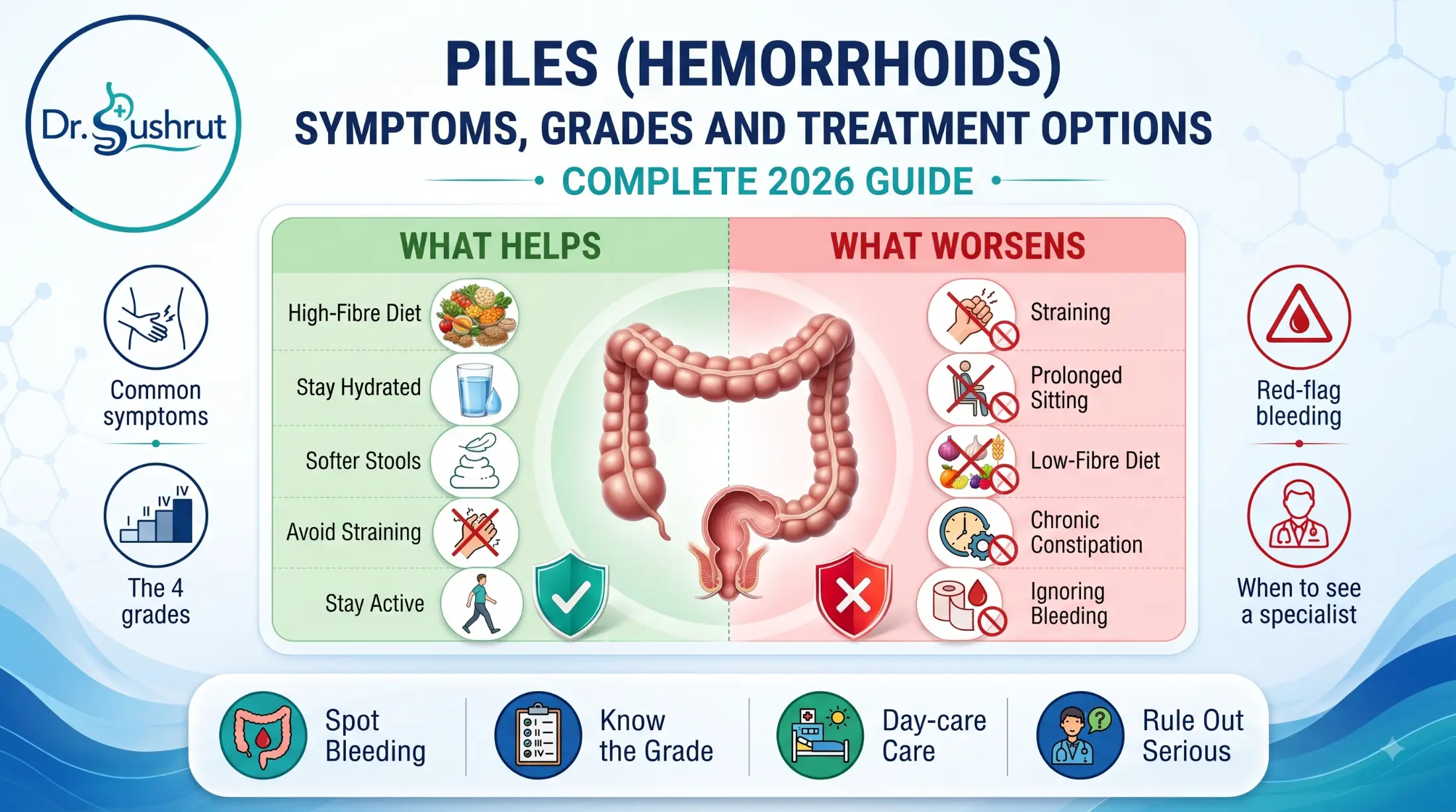
Noticing bright red blood after passing stool is frightening, and the first instinct is usually to hope it is “just piles” and wait for it to settle. Piles are extremely common – StatPearls notes that about 75% of adults experience hemorrhoidal symptoms at some point in life – but that very commonness is also the trap, because the same symptom can come from conditions that must never be missed. Knowing what piles are, how they are graded, and when bleeding needs a proper look is what keeps a minor problem minor.
Most online guides jump straight to creams and home fixes. This article, written to reflect how a DM Gastroenterology specialist assesses rectal bleeding, first makes sure the bleeding is actually from piles, then walks through every treatment option from lifestyle to day-care procedures, honestly, including what each one can and cannot do.
Key Takeaways
- Piles (hemorrhoids) are swollen blood vessels in the anal canal; they are common and usually treatable without major surgery.
- They are graded 1 to 4, and the grade decides the treatment, from fibre and creams up to day-care procedures.
- Bright red bleeding is the classic symptom, but bleeding should never be assumed to be piles without a specialist ruling out other causes.
- Most early piles settle with fibre, fluids, toilet habit changes and short-term topical treatment.
- Painless, effective office and day-care options exist well before open surgery becomes necessary.
What are piles?
Piles are cushions of blood vessels inside and around the anal canal that everyone has; they become a problem only when they swell, slip down or bleed.
Hemorrhoids (piles) – enlarged, engorged blood vessels in the lower rectum and anus. Internal piles sit inside the anal canal and are usually painless but bleed; external piles form under the skin at the anal opening and can be painful, especially if a clot forms inside them.
The main driver is repeated straining and raised pressure in these vessels – from constipation, prolonged sitting on the toilet, pregnancy, or a low-fibre diet. Chronic gas, bloating and irregular bowels that push you to strain are a frequent background factor, which is why fixing the bowel habit is central to fixing the piles.
Symptoms of piles
Typical symptoms depend on whether the piles are internal or external:
- Bright red blood on the toilet paper, in the pan, or streaking the stool.
- A soft lump or swelling at the anus, which may need pushing back after passing stool.
- Itching, irritation or a mucous discharge around the anus.
- Discomfort or a dragging sensation; sharp pain usually means an external clot (thrombosis) or a fissure rather than simple piles.
Piles do not cause dark or altered blood mixed through the stool, weight loss or a change in bowel calibre. Those point elsewhere and need assessment.
The four grades of piles
Internal piles are graded by how far they prolapse, and this grade drives the whole treatment decision.
| Grade | What happens | Usual approach |
|---|---|---|
| Grade 1 | Bleed but do not come out | Fibre, fluids, topical treatment |
| Grade 2 | Come out on straining, go back on their own | Diet plus office procedures |
| Grade 3 | Come out and need pushing back manually | Banding or day-care procedures |
| Grade 4 | Stay out and cannot be pushed back | Surgical or advanced day-care treatment |
Why bleeding must be checked, not assumed
This is the single most important point in the article. Bright red bleeding is usually piles, but colorectal cancer, polyps, inflammatory bowel disease and anal fissures can bleed in exactly the same way. A specialist takes a history, examines the area, and where there is any doubt – bleeding after 40, a change in bowel habit, anaemia, weight loss, or a family history of bowel cancer – arranges an endoscopic evaluation or colonoscopy to see the bowel directly. Treating piles you can feel while ignoring a cause higher up is the mistake that turns a curable problem into a late diagnosis. Confirming the source first is not over-caution; it is the standard of care.
Treatment options, from simple to advanced
Treatment is matched to the grade and to how much the piles affect daily life.
Conservative care (grades 1 to 2). A high-fibre diet, plenty of water, not straining or sitting long on the toilet, and short courses of topical creams or suppositories settle the majority of early piles. Stool softeners break the straining cycle.
Office and day-care procedures (grades 2 to 3). Rubber band ligation, sclerotherapy and infrared coagulation are quick, done without general anaesthesia, and have short recovery. Newer options such as Doppler-guided artery ligation and stapled procedures suit larger piles.
Surgery (grade 4 or failed measures). Formal haemorrhoidectomy is reserved for the largest or recurrent piles and gives durable results, with a longer recovery than the day-care options.
| Approach | Pros | Cons |
|---|---|---|
| Fibre and topical care | Safe, no procedure, treats the cause | Works only for early grades |
| Banding / day-care | Quick, no general anaesthesia, fast recovery | May need repeating; mild discomfort |
| Surgery | Durable for advanced piles | Longer recovery, done under anaesthesia |
If bleeding is recurring or a lump keeps coming out, it is worth choosing to book an assessment rather than cycling through pharmacy creams, because the right grade-based treatment is usually simpler than people fear.
Future trends in piles treatment
The direction of travel is toward less pain and faster recovery. Doppler-guided haemorrhoidal artery ligation, laser haemorrhoidoplasty and refined day-care techniques are reducing the need for conventional surgery, while better diagnostics help separate simple piles from causes that need a colonoscopy. The core message stays the same: earlier assessment means simpler, gentler treatment.
Conclusion
Piles are common and, in most people, very treatable with fibre, better toilet habits and grade-appropriate day-care procedures. The one rule that matters most is never to assume rectal bleeding is “just piles” – confirming the source first is what keeps a small, fixable problem from hiding a serious one.
Bleeding you have been putting off getting checked?
Dr. Sushrut Singh, a DM Gastroenterology specialist, first confirms where the bleeding is actually coming from, then matches treatment to the grade – most cases need day-care measures, not surgery. Consultations are at the Gaur City clinic in Greater Noida West, with endoscopic evaluation at Fortis Hospital, Sector 62.
Call or WhatsApp +91 93153 54431 to book. Getting it looked at early is the kindest thing you can do for yourself.
Frequently Asked Questions (FAQs)
Will piles go away on their own?
Early, grade 1 to 2 piles often settle with more fibre, more water and better toilet habits. Piles that keep prolapsing or bleeding usually need a simple procedure to resolve fully.
Is the bleeding from piles ever dangerous?
The blood loss itself is rarely dangerous, but the symptom must be confirmed as piles. The same bleeding can come from polyps or bowel cancer, which is why a specialist checks the source rather than assuming.
Are piles procedures painful?
Day-care options such as banding, sclerotherapy and infrared coagulation are done without general anaesthesia and cause only mild, short-lived discomfort for most people. Full surgery is reserved for advanced cases.
Can constipation cause piles?
Yes. Straining from constipation raises pressure in the anal vessels and is one of the most common triggers. Treating the constipation is part of treating the piles.
When should I see a doctor about piles?
See a specialist if bleeding is recurrent, if a lump keeps coming out, if there is pain, or if you are over 40 or have any change in bowel habit, weight loss or a family history of bowel cancer.