
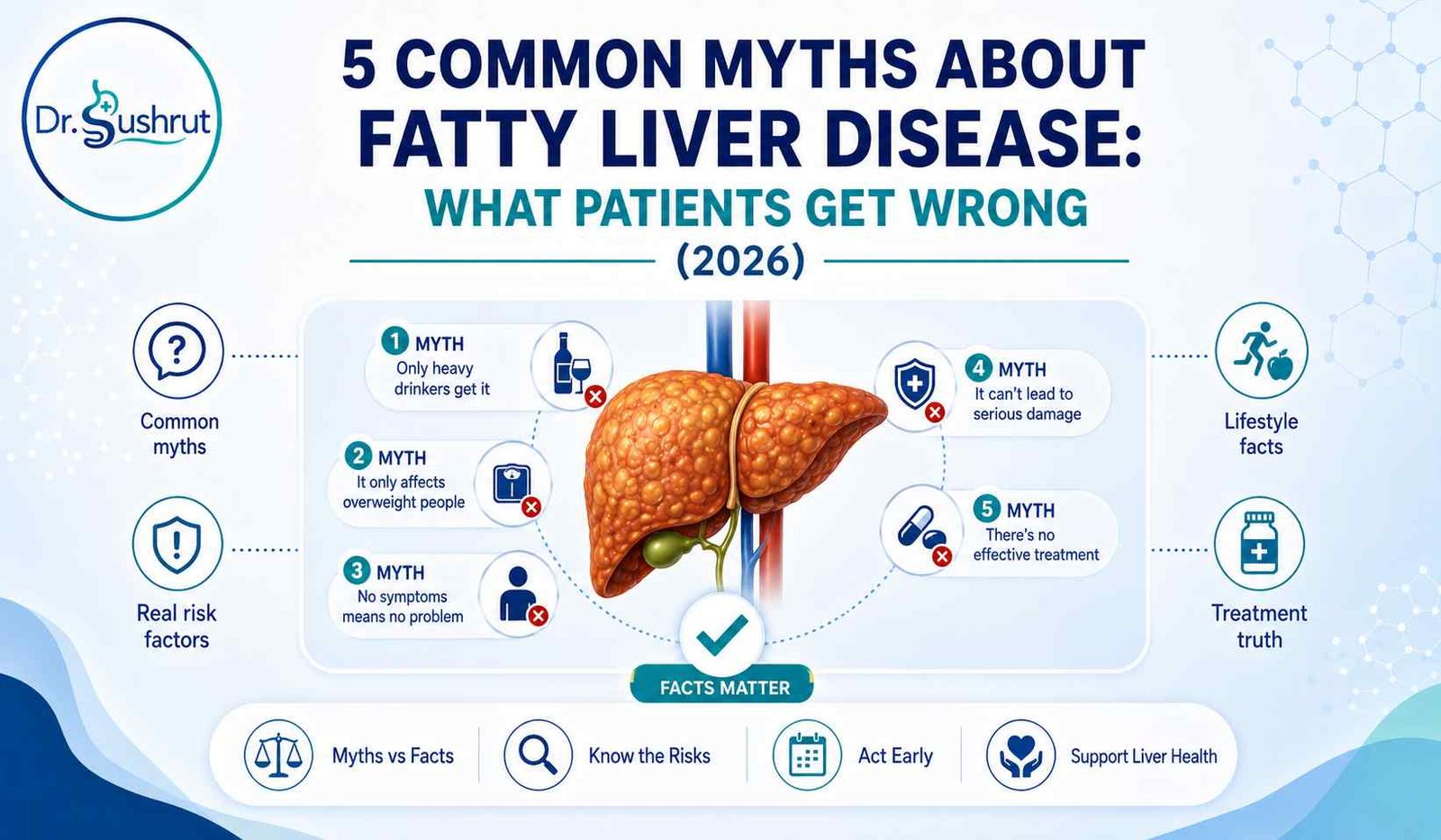
Fatty liver disease has quietly become one of the most common chronic conditions in India, and yet the misconceptions patients carry into consultations have barely changed in the last decade. Someone with an abnormal liver report will often self-diagnose using outdated internet sources or family advice before ever meeting a specialist. According to data published on PMC NCBI, non-invasive testing like FibroScan has made fatty liver detection significantly easier over the last five years, yet the myths that delay early treatment persist – and they are the reason patients present at stage 3 or 4 fibrosis when reversal is far harder than it needed to be.
This guide separates the five most common fatty liver myths from what the evidence actually shows. Each myth is a specific reason patients either dismiss the diagnosis when they should not, or panic over it when they need not. Understanding which of these you carried in with you is the first step to a rational conversation with your specialist about what to actually do next.
Key Takeaways
- Fatty liver affects both drinkers (AFLD) and non-drinkers (NAFLD) – alcohol is one cause, not the only one.
- Early-stage fatty liver is fully reversible with the right lifestyle changes; late-stage disease is not.
- Lean people can and do develop fatty liver, particularly in South Asian populations.
- Diet changes alone are usually not enough – regular exercise and modest weight loss matter equally.
- Fatty liver is silent in over 70% of cases; symptoms appear only when significant damage is already done.
Why Fatty Liver Myths Are So Common
Most fatty liver misconceptions come from one of three sources: outdated information that predates modern non-invasive diagnostics like FibroScan, family advice based on someone else’s very different case, or online content written for Western populations where the disease profile is different from what Indians actually experience. South Asian patients develop fatty liver at lower BMI thresholds and with different metabolic patterns than European or American populations – which means much of the general internet information is misleading before you even start reading. The right frame is Indian-specific evidence and a specialist who understands the local disease pattern.
The 5 Most Common Fatty Liver Myths vs Medical Reality
Below is a side-by-side comparison of the five most widely held beliefs against current gastroenterology practice. Recognising which of these you have absorbed is the fastest way to correct course:
| Common Myth | Medical Reality |
|---|---|
| Fatty liver only affects people who drink alcohol | Non-alcoholic fatty liver (NAFLD) is now more common than alcoholic fatty liver in India |
| Fatty liver cannot be reversed | Early-stage (grade 1-2) fatty liver is fully reversible with lifestyle changes |
| Only overweight people get fatty liver | Lean NAFLD exists – normal-weight South Asians can develop the disease |
| Diet alone will fix it | Diet + exercise + weight loss together give the strongest reversal rates; diet alone often falls short |
| You will feel symptoms if you have fatty liver | Over 70% of cases are silent until advanced fibrosis develops |
Recognising a myth on this list is easy; understanding what to actually do next is harder. That is where the Symptoms of Fatty Liver Disease guide comes in. It walks through the vague, easily-missed early clues (fatigue that no rest fixes, right-upper abdominal discomfort, poor appetite, unexplained mild jaundice) that most patients dismiss as work stress. If any of these overlap with what you have been experiencing, the myth-busting exercise on this page has an immediate follow-up: read the symptoms guide and match your experience to it before your next specialist visit. That matching is what turns a myth-buster read into an actual clinical decision.
Myth #1: ‘Fatty Liver Only Affects People Who Drink Alcohol’
This is the most damaging myth on the list because it makes non-drinkers assume they are safe from the diagnosis. In India today, non-alcoholic fatty liver disease (NAFLD) is now more common than alcoholic fatty liver disease. The main drivers of NAFLD are insulin resistance, sedentary lifestyle, high sugar and refined carbohydrate intake, obesity, and genetic factors that are particularly prevalent in South Asian populations.
A completely teetotal patient with a normal BMI can still have moderate-to-severe fatty liver on ultrasound or FibroScan. The trigger is not alcohol; it is metabolic dysfunction that quietly progresses over years. If your family doctor has told you your liver enzymes are mildly elevated, do not brush it off just because you do not drink – this is exactly the population NAFLD targets, and early identification changes the outcome significantly.
The direct financial consequence of catching fatty liver early is also worth knowing. The Fatty Liver Treatment Cost in Greater Noida guide breaks down what different stages of fatty liver actually cost to manage – from a simple lifestyle-focused plan for grade 1 disease to intensive multidisciplinary management for advanced fibrosis. The cost curve rises sharply with disease stage, which is one more reason not to dismiss early findings. Managing grade 1 fatty liver is a fraction of the cost of managing grade 3 fibrosis, both financially and in terms of quality of life.
Myth #2: ‘Fatty Liver Cannot Be Reversed’
This is partially true but dangerously oversimplified. Early-stage fatty liver (grade 1 and mild grade 2) is fully reversible with the right lifestyle changes – meaningful weight loss, dietary correction, regular exercise, and control of associated conditions like diabetes and dyslipidemia. Most patients who address the disease at this stage see complete resolution on repeat imaging within 6-12 months.
What is not reversible is advanced fibrosis (stage 3-4). Once significant scarring has developed in the liver, the process can be halted but the existing damage does not undo itself. This is why timing matters. The window for reversal is real but not infinite; the same lifestyle changes that reverse grade 1 disease will only stabilise grade 3 disease. The distinction between “cannot be reversed” and “cannot be reversed at this stage” is the entire point of catching the disease early.
The most important step in the reversal window is finding the right specialist. Consulting the Best Gastroenterologist in Greater Noida who has managed fatty liver at every stage will give you a specific, individualised reversal plan rather than a generic diet handout. A DM Gastroenterology specialist knows exactly which stage your case is at based on FibroScan results, what the realistic reversal timeline looks like for you, and which associated conditions (diabetes, thyroid, lipids) need to be co-managed to give the reversal plan a real chance. Generic advice from the internet cannot do this.
Myth #3: ‘Only Overweight People Get Fatty Liver’
Lean NAFLD is a well-recognised entity, particularly common in South Asians. A person with a BMI of 22 and a normal waist circumference by Western standards can still have significant fatty liver, driven by insulin resistance, visceral fat distribution, and genetic predisposition. The BMI cutoffs used in international guidelines were derived from European and American populations and consistently under-diagnose fatty liver in Indians.
If you have a strong family history of diabetes, elevated fasting insulin levels, high triglycerides, or metabolic syndrome features, screening for fatty liver is worthwhile even if your weight looks “normal” on a scale. FibroScan takes ten minutes and gives a clear answer.
Myths #4 and #5: ‘Diet Alone Will Fix It’ and ‘You Will Feel Symptoms’
Myth #4 is the “vegan detox will cure me” belief. Diet is essential but not sufficient on its own. The evidence consistently shows that the strongest reversal rates come from combined interventions – dietary changes plus at least 150 minutes of moderate exercise per week plus modest sustained weight loss (5-10% of body weight). Pure dietary interventions without exercise and weight loss show more modest results.
Myth #5 is the belief that “if my liver had a problem, I would feel it”. Fatty liver is silent in the vast majority of cases. Patients present with the disease found incidentally during routine ultrasound, on a health check-up abnormal enzyme result, or during workup for something unrelated. By the time actual symptoms appear (right upper abdominal pain, fatigue disproportionate to activity, mild jaundice, itching), significant damage has often already occurred. This is exactly why screening high-risk individuals is worthwhile even in the absence of symptoms.
Not Sure Which Stage Your Fatty Liver Is At?
The five myths above matter only after your case has been staged properly. Grade 1, grade 2, grade 3, grade 4 – each has a different management approach and a different realistic outcome. A ten-minute FibroScan gives that answer definitively; guessing based on ultrasound reports and family opinion does not.
Call Dr. Sushrut: +91 93153 54431
WhatsApp Your Recent Reports for Review
Future Trends: What’s Changing in 2026
FibroScan is becoming standard-of-care in fatty liver assessment and is available at more centres in Greater Noida each year. New medications for advanced NAFLD (semaglutide and its class, resmetirom) are entering Indian markets, giving specialists options that did not exist five years ago. AI-assisted analysis of routine ultrasound is improving early detection at the primary care level. For patients, the practical impact is that fatty liver is being caught earlier and managed with more tools than before – but only if patients present for evaluation, which the myths on this list often prevent.
Conclusion
The five myths on this list are collectively the single biggest reason Indian patients present with fatty liver at stages harder to reverse. None of them are difficult to correct once the patient has heard the actual clinical picture; all of them are easy to hold onto in the absence of a proper conversation with a specialist. Match your beliefs against this list, then have that conversation before you decide what your next step is.
Now That You Know the Truth – What to Do This Week
For each myth you were carrying, here is one specific action you can take within the next seven days:
| If you believed… | Do this within 7 days |
|---|---|
| Fatty liver only affects drinkers | Get a FibroScan or liver ultrasound if you have not had one in 2 years |
| Fatty liver cannot be reversed | Ask your specialist which stage you are actually at (grade 1, 2, 3, or 4) |
| Only overweight people get it | Ask for a metabolic panel: fasting insulin, HbA1c, triglycerides, lipid profile |
| Diet alone will fix it | Add 30 minutes of walking or moderate exercise, 5 days per week starting Monday |
| You would feel it if you had it | Book a baseline liver assessment if you have any risk factors (diabetes, family history, elevated enzymes) |
One action from this list will change more than reading ten more myth-buster articles.
Frequently Asked Questions (FAQs)
Can fatty liver progress to liver cancer?
Yes, but only in advanced stages and in a minority of cases. Fatty liver that progresses to cirrhosis carries a small but real risk of hepatocellular carcinoma over years, which is why staging matters and why cirrhosis patients need regular surveillance. Early-stage fatty liver (grade 1-2) that is caught and reversed does not carry this risk. The cancer risk is a stage-4 concern, not a stage-1 one – another reason early diagnosis and intervention matters.
How is fatty liver diagnosed and how accurate are the tests?
The primary tests are ultrasound (detects fat but does not stage severity well), FibroScan (staging by liver stiffness measurement, non-invasive, 10 minutes), and liver biopsy (gold standard but invasive, reserved for unclear cases). Blood-based markers like ALT/AST and specialised panels support the diagnosis. For most patients, ultrasound plus FibroScan gives an accurate answer without needing biopsy. Discuss which combination is right for your case with your specialist.
Are there medications that reverse fatty liver?
Not directly for uncomplicated grade 1-2 NAFLD – the treatment there is lifestyle-based. For advanced NAFLD with fibrosis, some newer medications like resmetirom show promise and are becoming available in India. Vitamin E has a role in specific patient subgroups. Diabetes medications like semaglutide help patients with coexistent diabetes and fatty liver. Any medication decision needs specialist input; do not self-medicate based on internet reports of a specific drug.
How often should fatty liver patients be monitored?
Grade 1 disease typically needs re-evaluation every 12 months; grade 2 every 6-12 months; grade 3-4 every 3-6 months. Monitoring includes liver enzymes, FibroScan, and assessment of associated conditions. The frequency also depends on whether you are actively pursuing reversal or holding steady, and whether other risk factors (weight, diabetes control, alcohol) are changing. Your specialist sets the interval based on your specific case.
Book Your Consultation at Either Location
Both clinics offer the same specialist evaluation and staging expertise. Choose the location most convenient for you:
Gaur City Clinic – Greater Noida West
Fortis Hospital – Sector 62
Same specialist. Same standards. Your choice of location.