
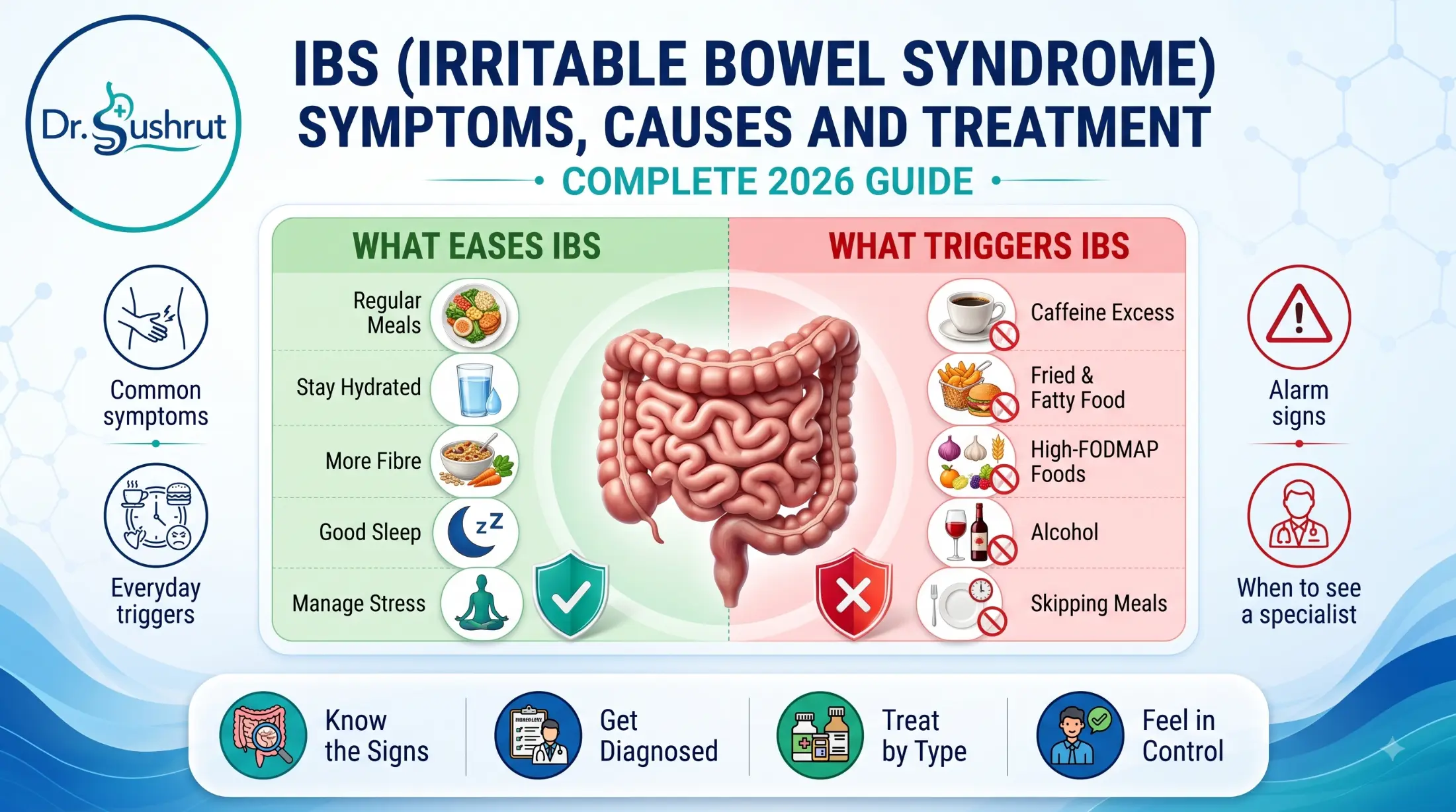
If your stomach cramps, bloats or sends you rushing to the toilet after almost every meal, and every test your doctor has run comes back “normal”, you are not imagining it and you are far from alone. Irritable bowel syndrome is one of the most common reasons people see a gut specialist, with an international review estimating a pooled global prevalence of about 11%. It is real, it is manageable, and understanding it is the first step to getting your days back.
Most articles on IBS either dismiss it as “just stress” or bury you in a list of foods to avoid. This guide, reviewed against the way a DM Gastroenterology specialist actually works up these symptoms, explains what IBS is, how it is diagnosed without unnecessary tests, and the practical, stepwise treatment that helps the majority of patients feel in control again.
Key Takeaways
- IBS is a genuine disorder of gut-brain interaction, not a psychological label or a sign that “nothing is wrong”.
- It is diagnosed clinically using symptom patterns (the Rome criteria) plus a few targeted tests to rule out other conditions, not by a single scan.
- The three main types are IBS-D (diarrhoea), IBS-C (constipation) and IBS-M (mixed).
- Alarm features such as bleeding, weight loss, anaemia or a family history of bowel cancer need prompt evaluation and are not typical of IBS.
- Treatment is stepwise: diet, fibre and lifestyle first, then targeted medication and gut-brain therapies, tailored to your subtype.
What is Irritable Bowel Syndrome?
IBS is a long-term condition in which the gut is oversensitive and its muscle movements are poorly coordinated, producing pain and altered bowel habits without any visible damage to the bowel wall.
Irritable bowel syndrome (IBS) – a disorder of gut-brain interaction in which abdominal pain is linked to a change in how often you pass stool or how it looks, in the absence of structural disease. The nerves and muscles of the gut overreact to normal triggers such as food, stress or hormonal shifts.
Because the bowel looks normal on a camera test, older doctors sometimes called it a “functional” problem. That word was unhelpful. The dysfunction is real; it simply lives in how the gut and brain communicate rather than in a growth or an ulcer. Persistent lower-abdominal cramping, along with recurring gas and bloating that eases after passing stool or wind, is the pattern that most often points here.
Common symptoms of IBS
The symptoms come and go in flares, often for years, and typically include:
- Cramping or aching in the lower abdomen, usually relieved by opening the bowels.
- Bloating and visible abdominal distension that builds through the day.
- Diarrhoea, constipation, or an alternating pattern between the two.
- A feeling of incomplete emptying, or mucus in the stool.
- Symptoms triggered or worsened by meals, stress, or the menstrual cycle.
IBS does not cause bleeding, fever, or weight loss. Those are “alarm” symptoms that belong to other conditions and should always be assessed by a specialist rather than assumed to be IBS.
What causes IBS?
There is rarely a single cause. IBS usually develops from several factors acting together:
- Gut-brain sensitivity: the nerves supplying the bowel signal pain at pressures a normal gut would ignore.
- Altered motility: the bowel muscle squeezes too fast (diarrhoea) or too slowly (constipation).
- Post-infective change: a severe episode of food poisoning or gastroenteritis can trigger IBS that lingers long after the infection clears.
- Gut microbiome shifts and diet: certain fermentable carbohydrates draw water and produce gas in a sensitive gut.
- Stress and sleep: they do not cause IBS on their own, but they turn the volume up on a gut that is already primed.
How IBS is diagnosed
This is where a DM Gastroenterologist adds real value, because good diagnosis means confirming IBS confidently while ruling out the conditions that mimic it, without ordering every test in the book. Assessment usually involves a detailed symptom history against the Rome criteria, a clinical examination, and a small, targeted panel: blood counts, thyroid and coeliac screening, and inflammatory markers. Where diarrhoea, bleeding, anaemia or a family history of bowel cancer is present, a diagnostic endoscopy or colonoscopy is arranged to exclude inflammatory bowel disease and other structural causes. If every alarm feature is absent and the pattern fits, IBS can be diagnosed with confidence and treatment can begin.
| Feature | Typical of IBS | Needs further tests |
|---|---|---|
| Onset age | Usually under 50 | New symptoms after 50 |
| Bleeding | Absent | Blood in stool |
| Weight | Stable | Unexplained weight loss |
| Night symptoms | Rare | Waking at night to pass stool |
| Blood tests | Normal | Anaemia or raised inflammatory markers |
Treatment: a stepwise plan
IBS is managed, not cured, and most people do well once the plan is matched to their subtype. Care is built in layers.
First line – diet and lifestyle. Regular meals, adequate hydration, soluble fibre for IBS-C, reduced caffeine and alcohol, and a structured low-FODMAP trial supervised by a dietitian help a large share of patients. Physical activity and better sleep genuinely reduce flare frequency.
Second line – targeted medication. Antispasmodics for cramping, laxatives such as macrogol for IBS-C, loperamide for IBS-D, peppermint oil for pain and bloating, and specific prescription agents for stubborn cases. The medicine is matched to the dominant symptom rather than given as a blanket prescription.
Third line – gut-brain therapies. Low-dose neuromodulators, gut-directed cognitive behavioural therapy and hypnotherapy work on the oversensitive gut-brain axis and are offered when symptoms are persistent. If self-care has not settled things within a few weeks, it is sensible to book an assessment so the plan can be personalised rather than guessed at.
| Approach | Pros | Cons |
|---|---|---|
| Diet and lifestyle first | Safe, addresses the root triggers, no medication | Needs patience and dietitian support |
| Medication by subtype | Fast symptom relief | Treats symptoms, not the sensitivity |
| Gut-brain therapies | Targets the core mechanism, durable | Takes weeks, needs a trained therapist |
Future trends in IBS care
IBS care is moving from one-size-fits-all toward precision. Microbiome profiling is being studied to predict who responds to which diet, breath testing is refining the small-intestinal bacterial overgrowth overlap, and newer gut-selective drugs aim to calm pain signalling without constipating or loosening the bowel. Digital gut-directed therapy delivered through apps is making behavioural treatment far easier to access. None of these replaces a careful diagnosis, but together they point to more personalised, less trial-and-error management in the next few years.
Conclusion
IBS is common, real and highly manageable once it is diagnosed properly and treated by subtype rather than by guesswork. Confirming the diagnosis, excluding the conditions that mimic it, and building a layered plan around your triggers is what turns years of unpredictable symptoms into good, ordinary days.
Living around your gut instead of the other way round?
A structured IBS work-up with Dr. Sushrut Singh, a DM Gastroenterology specialist at the Gaur City clinic in Greater Noida West, confirms the diagnosis and builds a subtype-specific plan – no unnecessary tests, no blanket medication.
Call or WhatsApp +91 93153 54431 to book your consultation. Advanced tests, where needed, are arranged at Fortis Hospital, Sector 62.
Frequently Asked Questions (FAQs)
Is IBS dangerous or does it lead to cancer?
IBS does not damage the bowel and does not turn into cancer. It affects quality of life, not life expectancy. Bleeding, weight loss or anaemia are not part of IBS and should be checked promptly.
Can IBS be cured completely?
IBS is controlled rather than cured. Most people reach long stretches with few or no symptoms once diet, medication and gut-brain triggers are managed together.
Which foods commonly trigger IBS?
Common triggers include excess caffeine, alcohol, fatty or fried food, and high-FODMAP items such as onions, wheat, some pulses and certain fruits. Triggers vary between people, so a supervised elimination trial works better than a fixed list.
How do I know if it is IBS or something more serious?
A specialist confirms IBS by matching your symptom pattern to the Rome criteria and checking for alarm features. If any red flag is present, a few targeted tests settle the question quickly.
Does stress cause IBS?
Stress does not create IBS on its own, but it amplifies a gut that is already sensitive. Managing stress and sleep is part of treatment, not the whole cause.